
Tribal Water Rights in the Colorado River Basin
Federal Indian reserved water rights are among the most senior legal entitlements in the American West — and among the least understood. Nowhere is that gap between legal reality and public awareness more consequential than in the Colorado River Basin, where thirty federally recognized tribes hold water rights that predate, and in most cases are senior to, virtually every state and private entitlement in the system.
In 1990, ten of those tribes formed the Colorado River Basin Ten Tribes Partnership — a coalition created to give tribal water interests a unified voice in basin-wide water policy discussions from which Indigenous nations had historically been excluded. The Partnership's member tribes span both the Upper and Lower Basins across six states: the Navajo Nation, Hopi Tribe, Southern Ute Indian Tribe, Ute Mountain Ute Tribe, Ute Indian Tribe of the Uintah and Ouray Reservation, Jicarilla Apache Nation, Fort Mojave Indian Tribe, Colorado River Indian Tribes, Chemehuevi Indian Tribe, Quechan Indian Tribe, and Cocopah Indian Tribe. Together, they hold legal entitlements to nearly 2.8 million acre-feet per year — more water than the basin reliably delivers under current hydrological conditions.
In 2018, the Partnership and the Bureau of Reclamation jointly published the Colorado River Basin Ten Tribes Partnership Tribal Water Study, the most comprehensive accounting of tribal water rights, current use, and development scenarios ever produced for the basin. That study is the primary data source for much of what follows.
Understanding tribal water rights in the Colorado River Basin requires understanding both where they come from and why so little of what the law promises has been realized.
The Winters Doctrine
The legal foundation is a 1908 Supreme Court decision, Winters v. United States, arising from a dispute on the Milk River in Montana. The Fort Belknap Indian Reservation depended on the river for agriculture, but upstream non-Indian settlers were diverting so much water that the river ran dry before it reached the reservation. The settlers argued that their diversions were lawful under Montana's prior appropriation law. The Supreme Court disagreed.
The Court held that when the federal government established an Indian reservation, it implicitly reserved — by operation of federal law — sufficient water to fulfill the reservation's purpose. That reservation of water carried a priority date equal to the founding of the reservation itself, not the date of first use. Under the prior appropriation system that governs western water, an 1855 reservation priority date makes that water right senior to nearly every non-Indian claim in the basin. The right does not have to be used to be preserved. It cannot be forfeited or abandoned. And it cannot be extinguished except by act of Congress.
The Winters doctrine established a legal reality that the rest of western water law has been working around ever since: Indian tribes hold water rights that are, in most cases, the oldest and most senior in their watersheds — rights that were never extinguished and, in many cases, have never been fully quantified.
Arizona v. California and the Lower Basin Tribes
The doctrine's most consequential application in the Colorado River Basin came in Arizona v. California, the decades-long Supreme Court case that resolved Lower Basin apportionments. In its 1963 decision, the Court confirmed Arizona's entitlement to 2.8 million acre-feet annually from the mainstream river — but it also did something that had no precedent in Colorado River law. It recognized that five tribes held federally reserved water rights senior to virtually every other claim in the Lower Basin.
The Court quantified those rights using the "practicably irrigable acreage" standard — the amount of water needed to irrigate all reservation land physically capable of sustained cultivation under reasonably available technology. That standard produced the present perfected rights decreed for the five Partnership Tribes in the Lower Basin: the Fort Mojave Indian Tribe, Chemehuevi Indian Tribe, Colorado River Indian Tribes, Quechan Indian Tribe, and Cocopah Indian Tribe.
The Consolidated Decree of 2006 — the culmination of supplemental proceedings following the original decision — set those rights in their current form:
Fort Mojave Indian Tribe: 132,789 AFY across Arizona, California, and Nevada, with priority dates of 1890 and 1911. The Tribe carries some of the most senior priority dates among the Lower Basin tribes and is currently diverting approximately 85,600 AFY, nearly all for irrigated agriculture. The Tribe funds its own water development without a federal irrigation project and was projecting use of approximately 95 percent of its right by 2020.
Colorado River Indian Tribes: 719,248 AFY across Arizona and California — the largest tribal water right in the Lower Basin. The Tribe's Arizona right carries a priority date of March 3, 1865 — among the earliest in the Lower Basin — and is nearly fully developed through the Colorado River Irrigation Project. The California right of 56,846 AFY, by contrast, is largely undeveloped due to the absence of delivery infrastructure on the California side of the reservation — a gap that represents both an unresolved water management challenge and a significant economic opportunity.
Quechan Indian Tribe: 77,966 AFY across Arizona and California, with a priority date of January 9, 1884. The Tribe currently diverts approximately 61,600 AFY, including 13,000 AFY made available to the Metropolitan Water District of Southern California through a forbearance arrangement authorized by the Consolidated Decree. The Tribe has also dedicated approximately 1,300 AFY to the Yuma East Wetlands, a habitat restoration project undertaken in partnership with the City of Yuma and federal agencies.
Chemehuevi Indian Tribe and Cocopah Indian Tribe: The Chemehuevi hold 11,340 AFY in California (priority date 1907), of which approximately 307 AFY is currently used — poor soil quality limits agricultural development, and the right remains largely undeveloped. The Cocopah hold 10,847 AFY in Arizona (priority dates 1915–1917), plus an unresolved claim of approximately 22,928 AFY for lands acquired in trust in 1985. Current Cocopah use is approximately 6,973 AFY, almost entirely for irrigated agriculture on leased farmland; the Tribe's East Reservation — 4,200 acres — lacks irrigation delivery infrastructure entirely. Both tribes' rights represent significant unrealized potential constrained primarily by infrastructure and funding gaps rather than legal uncertainty.
The Consolidated Decree also established a critical protection for these five tribes in the event of shortage: the Secretary of the Interior must satisfy tribal present perfected rights in full before delivering water to other Lower Basin users. System modeling conducted for the 2018 Tribal Water Study found that total Lower Basin shortage would have to exceed approximately 6.78 million acre-feet before the tribes' present perfected rights would be affected — a threshold reached in fewer than one percent of modeled years, even under projected climate conditions.
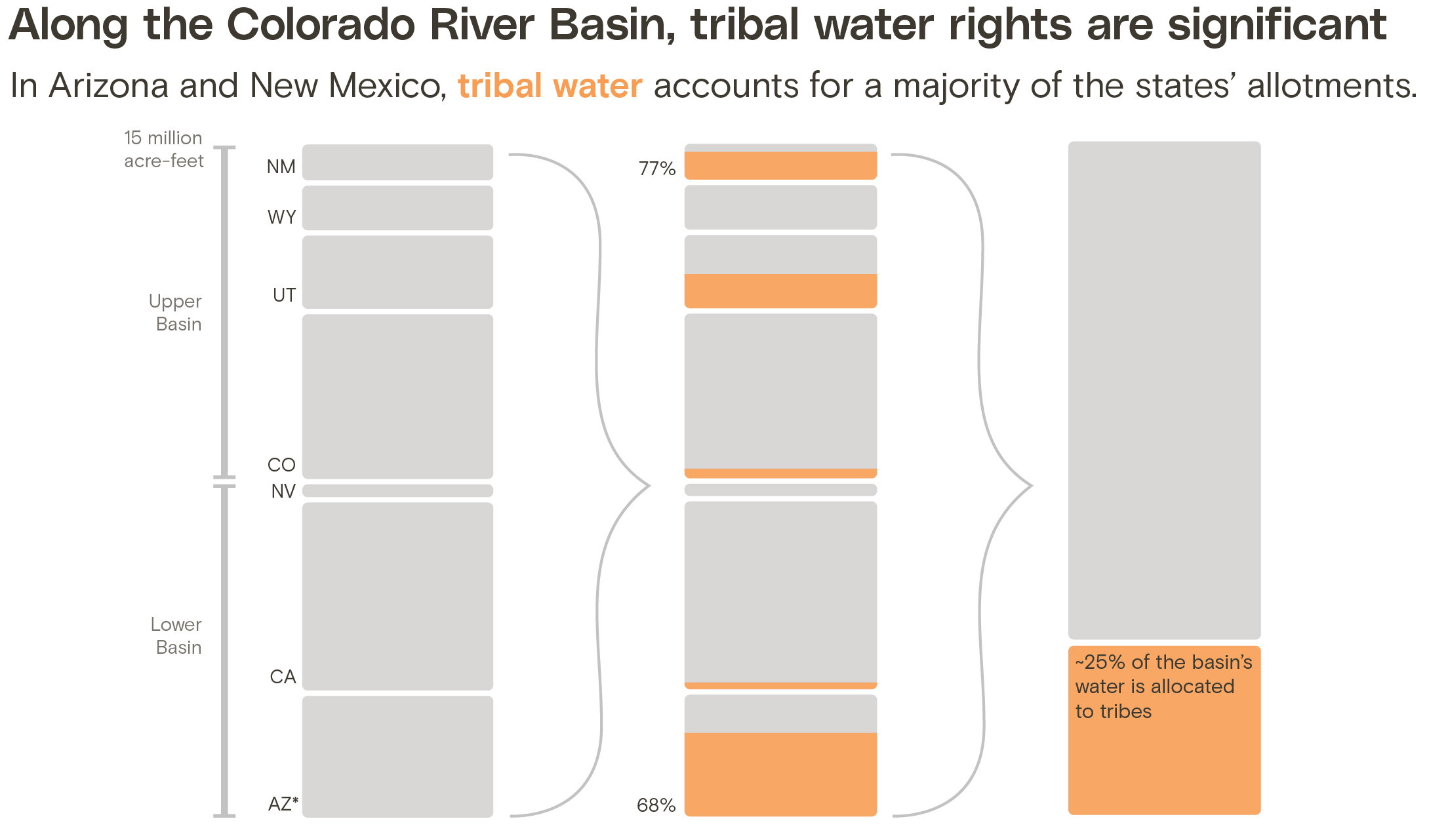
Tribal water accounts for 68% of Arizona's Colorado River allocation and 77% of New Mexico's — among the highest shares of any basin state. Data reflects resolved and partially resolved rights as of 2018 under a 15-million acre-foot scenario. Jessie Blaeser / High Country News & Grist. Source: Babbitt Center for Land and Water Policy's Colorado River Basin GIS Open Data Portal; Womble et al. 2018.
Upper Basin Tribes and Congressional Settlements

In the Upper Basin, the legal framework developed differently. Rather than through Supreme Court adjudication, most Upper Basin tribal water rights have been quantified through negotiated settlements ratified by Congress — a process that began in earnest in the 1970s and 1980s and continues today.
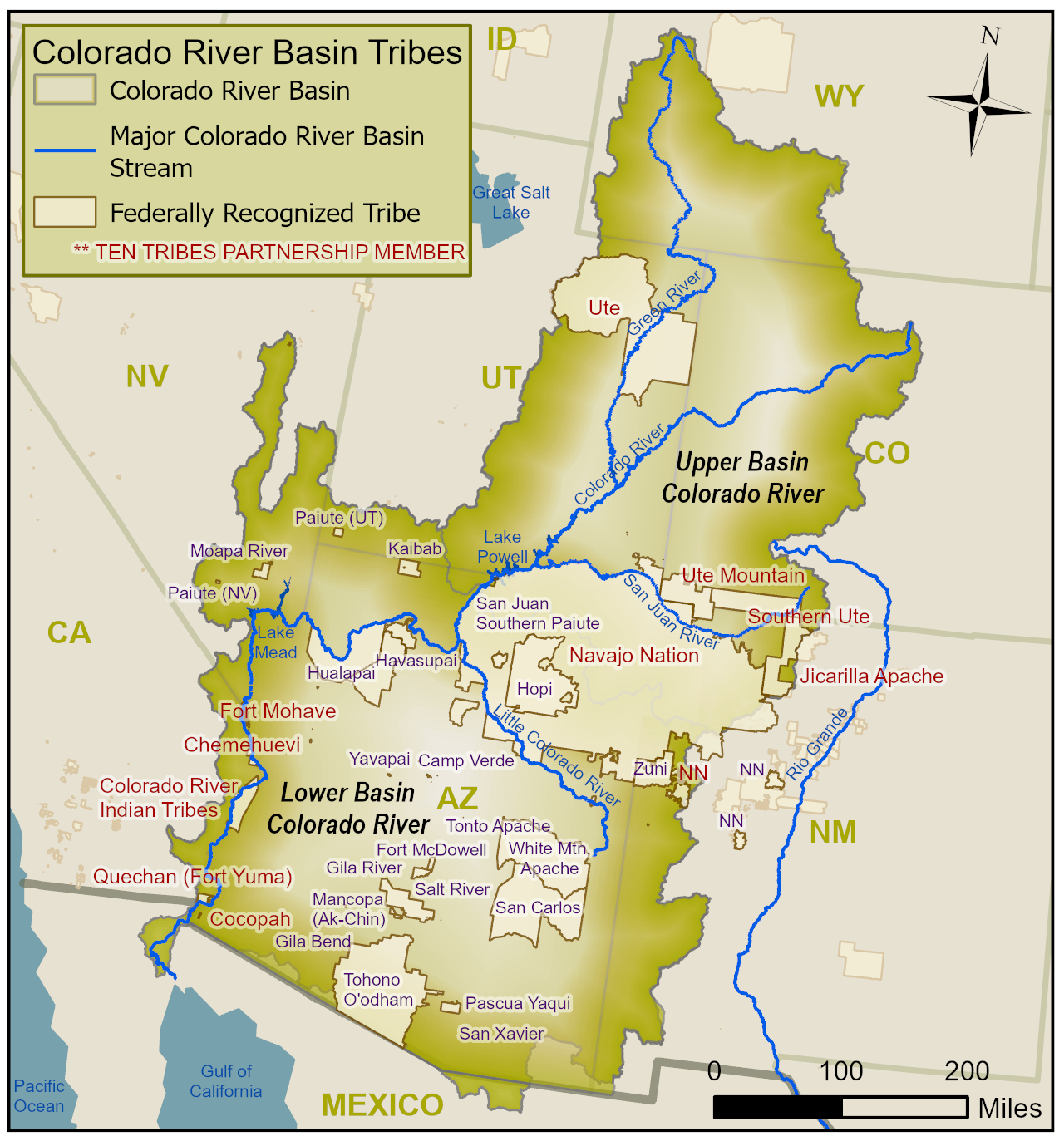
Federally recognized tribal lands in the Colorado River Basin. Tribes hold approximately 25% of the river's historical average annual flow in water rights — senior, by federal law, to virtually every non-tribal entitlement in the basin. Jessie Blaeser / High Country News & Grist. Source: Babbitt Center for Land and Water Policy's Colorado River Basin GIS Open Data Portal; Womble et al. 2018.
Southern Ute Indian Tribe and Ute Mountain Ute Tribe: Both tribes' rights were quantified through the Colorado Ute Indian Water Rights Settlement Act of 1988, implementing settlements negotiated over more than a decade. The settlements are tied to the Animas–La Plata Project — a water storage and delivery facility whose centerpiece is Lake Nighthorse, a reservoir near Durango, Colorado. The Southern Ute holds 128,939 AFY in settled diversion rights; the Ute Mountain Ute holds 100,184 AFY in Colorado, with rights in New Mexico and Utah remaining unresolved.
Current use falls well below those rights. The Southern Ute diverts approximately 41,300 AFY, the Ute Mountain Ute approximately 25,200 AFY. The gap reflects both the condition of existing delivery infrastructure — the Pine River Indian Irrigation Project, which serves much of the Southern Ute's agricultural acreage, is more than a century old — and the challenges of developing Lake Nighthorse water, which requires a pipeline the Ute Mountain Ute has not yet been able to fund.
Ute Indian Tribe (Uintah and Ouray Reservation): The Ute Indian Tribe holds the most senior water right of any user in the Colorado River Basin. The Tribe's priority date of 1861 — tracing to the establishment of the Uintah Valley Reservation — predates every other tribal or non-tribal claim in the basin. In a prior appropriation system where seniority is everything, that date matters: the Ute Indian Tribe's decreed right stands ahead of every other water user across both the Upper and Lower Basins in any shortage accounting that reaches their water.
The Tribe holds a decreed diversion right of 179,315 AFY in Utah, administered through a combination of the Uintah Indian Irrigation Project and tribal water development. But the decreed right is only part of the story. The Tribe also holds unresolved claims to an additional 370,370 AFY that were formally deferred in 1965 pending further proceedings — deferred, not relinquished. Those claims represent one of the largest bodies of unquantified tribal water rights in the Colorado River Basin and have been pending resolution for six decades. Current diversions run approximately 212,500 AFY, a figure that reflects both the Tribe's active use of its decreed right and deliveries through Reclamation infrastructure, but that falls well short of the full scope of what the Tribe's legal entitlement — decreed and deferred — would authorize.
The combination of the 1861 priority date, the scale of deferred claims, and Utah's position in the Upper Basin gives the Ute Indian Tribe's water rights outsized significance in the post-2026 renegotiation. Upper Basin states bear a delivery obligation at Lee Ferry, and tribal reserved rights with priority dates senior to essentially every non-tribal use in the basin sit upstream of that calculation. How the Tribe's deferred claims are ultimately quantified and administered will shape Utah's water future in ways that the state's water planners are still working through.
Jicarilla Apache Nation: The Jicarilla Apache Tribe Water Rights Settlement Act of 1992 confirmed a diversion right of 45,683 AFY in New Mexico. The Jicarilla have built their water program around marketing rather than direct on-reservation use: most of their currently diverted water is leased to off-reservation users including utilities, a mining company, and the City of Santa Fe. The Jicarilla program is the most fully realized example in the basin of tribes converting senior water rights into an economic development asset — and the legal framework it established under the Settlement Act has become a model for tribal water marketing discussions elsewhere.
Navajo Nation
No tribe in the Colorado River Basin occupies a more complex legal position than the Navajo Nation. The Nation holds claims spanning the Upper Basin, the Lower Basin, and the Little Colorado River system — across three states, under three separate legal frameworks, at three different stages of resolution.
New Mexico: The Nation's rights in New Mexico are the most fully resolved. Through the Navajo-San Juan River Adjudication process, diversion rights of approximately 606,660 AFY have been confirmed — the largest block of quantified Navajo water rights. The Navajo-Gallup Water Supply Project, authorized in 2009, is the primary infrastructure under construction to deliver that water to Navajo communities, the Jicarilla Apache Nation, and the city of Gallup.
Utah: In Utah, the Nation's rights remain unresolved. A proposed settlement would confirm diversion rights of approximately 315,000 AFY from the San Juan River, subject to a maximum annual depletion of 81,500 AFY, but Congress has not ratified it. Resolution of the Utah settlement is a necessary companion to the Arizona settlement described below.
Arizona: Arizona presents the largest remaining unresolved Navajo water rights question — and the largest pending Indian water settlement in American history by authorized federal cost. After decades of negotiation, the Navajo Nation, Hopi Tribe, and San Juan Southern Paiute Tribe reached agreement with the State of Arizona on the Northeastern Arizona Indian Water Rights Settlement Agreement, signed May 9, 2024. All three tribal councils approved the settlement unanimously; Arizona Governor Katie Hobbs signed it on November 19, 2024. Arizona's congressional delegation introduced implementing legislation in both chambers and, when that session ended without floor action, reintroduced the Northeastern Arizona Indian Water Rights Settlement Act of 2025 (S. 953 / H.R. 2025) in March 2025.
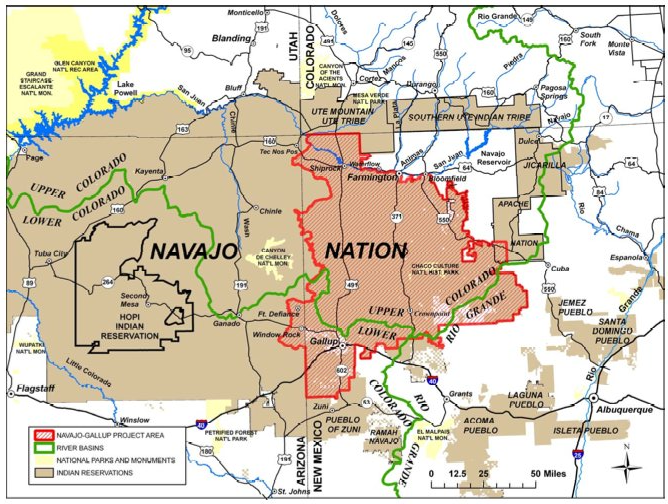
Navajo-Gallup Water Supply Project service area, showing Upper and Lower project reaches within the Navajo Nation and adjacent tribal lands. Source: U.S. Bureau of Reclamation, Navajo-Gallup Water Supply Project Final Environmental Impact Statement.
The settlement would authorize approximately $5 billion in federal funding for water infrastructure — the largest Indian water settlement in American history. The primary component is a Bureau of Reclamation pipeline that would carry Colorado River water from Lake Powell to communities across the Navajo Nation, with a completion deadline of 2040. The settlement also establishes a Navajo Nation Water Settlement Trust Fund covering construction, operations and maintenance, renewable energy, and agricultural conservation, and confirms the Nation's entitlement to approximately 48,300 AFY of Colorado River water in Arizona, with authorization to lease a portion off-reservation until on-reservation demand is met through new infrastructure.
All parties are in agreement. The legislation has bipartisan sponsors in both chambers. And yet it has not moved. The settlement's provisions affecting Upper Basin water use and the leasing authorization intersect directly with the post-2026 basin-wide negotiations underway, and that overlap appears to have slowed congressional action. In the meantime, approximately one-third of homes on the Navajo, Hopi, and San Juan Southern Paiute reservations still lack access to running water.
The Infrastructure Gap
Legal entitlement and actual water delivery are not the same thing. For most tribal water users in the Colorado River Basin, the gap between what the law recognizes and what water actually reaches tribal communities is large, durable, and rooted in a specific history.
Congress and the Bureau of Reclamation built the major Colorado River storage and delivery projects to serve non-Indian agriculture and growing southwestern cities. Tribal delivery systems, where they exist at all, were built later, funded at lower levels, and maintained less consistently. The result is a pattern in which tribes hold senior legal rights to a resource whose delivery infrastructure was designed around someone else.
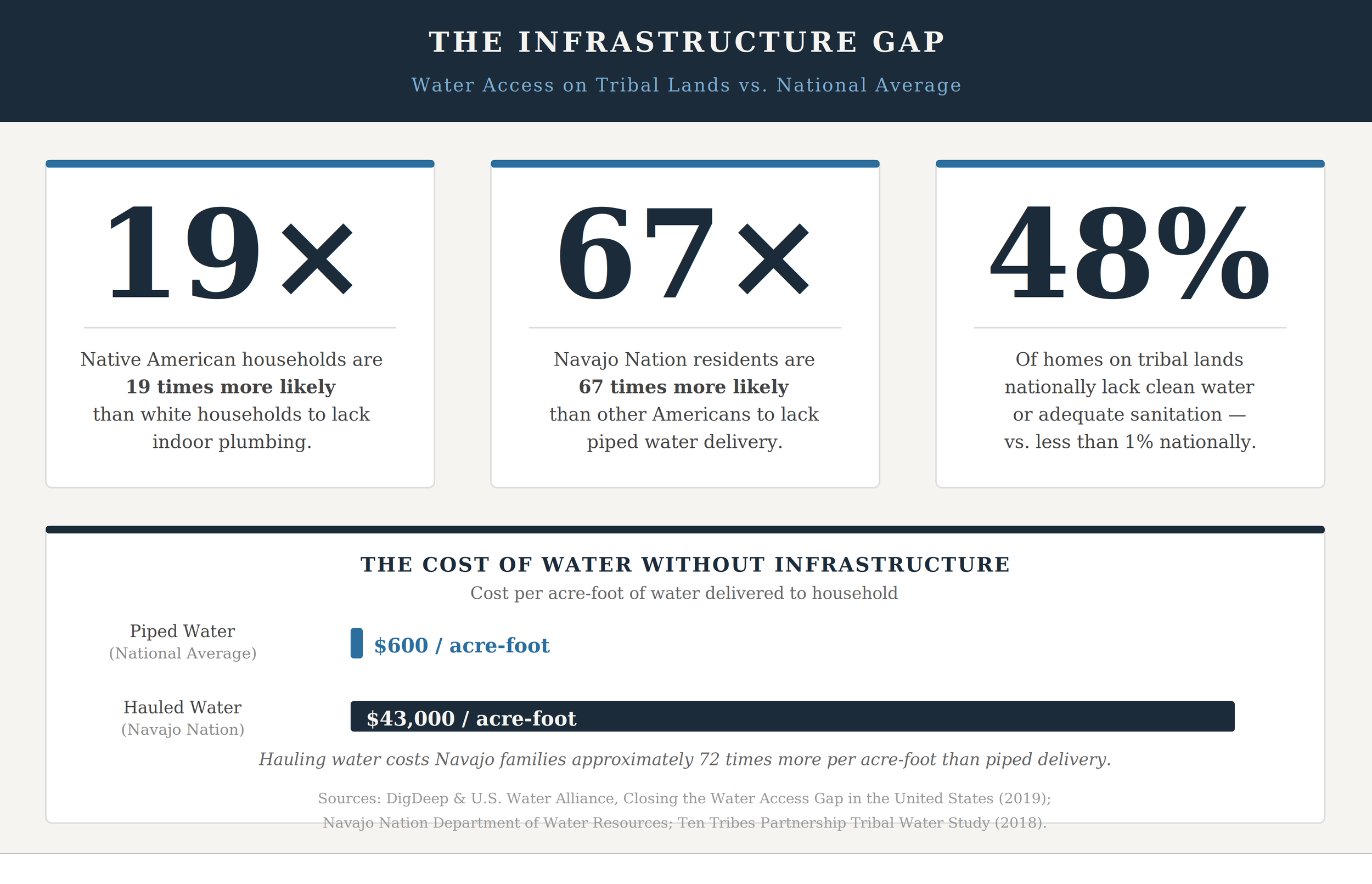
The consequences are concrete. Tribal households are far more likely to haul water from unprotected sources than non-tribal households — at costs that dwarf what connected households pay for piped service. Federal irrigation projects serving tribal lands have been chronically underfunded for operations and maintenance relative to non-Indian projects of comparable scale, compounding infrastructure deficits over decades. Across the Partnership Tribes, the gap between decreed rights and current use reflects not legal uncertainty but physical inability to deliver the water the law already recognizes.
Off-Reservation Water Marketing
Tribes are the only water rights holders in the Colorado River Basin with sufficient volumes of senior, legally established rights to make off-reservation water leasing consequential at a basin scale. The structural deficit is measured in millions of acre-feet; the water that could be leased, stored, or transferred from tribal portfolios is measured in the same units. That asymmetry is why tribal water marketing has moved from a peripheral legal question to a central one in the post-2026 negotiations.
The Legal Barrier: The Indian Non-Intercourse Act
The foundational constraint on tribal water marketing is not water law — it is federal Indian law. The Indian Non-Intercourse Act prohibits commercial transactions involving assets held in trust by the United States for the benefit of a tribe without federal authorization. Water rights held by tribes are trust assets. A tribe cannot independently lease, sell, or transfer those rights to a third party without running into the Act's prohibition. The practical consequence is that off-reservation tribal water marketing requires either specific congressional authorization or explicit Secretarial approval — the federal government must authorize any transaction that would transfer the beneficial use of trust water off the Indian reservation for which it was impliedly reserved.
This is why the Jicarilla Apache Settlement Act and the CRIT legislation discussed below are not simply convenient policy vehicles. They are legal prerequisites. Without congressional authorization, the leasing programs those acts enable would be invalid under federal law regardless of what the tribe, the lessee, or the State Engineer agreed to.
The Jicarilla Model
The Jicarilla Apache Tribe Water Rights Settlement Act of 1992 was the first congressional authorization of a tribal off-reservation water marketing program in the Colorado River Basin. The Act confirmed the Jicarilla Apache Nation's 45,683 AFY diversion right in New Mexico and expressly authorized the Nation to lease that water to off-reservation users — a provision that was, at the time, a significant legal innovation.
The Jicarilla have built their entire water program around that marketing authority. Most of their currently diverted water is leased to utilities, a mining operation, and the City of Santa Fe. In a state with New Mexico's population density and infrastructure constraints, the volumes involved — tens of thousands of acre-feet per year — make the Jicarilla program a material contributor to the regional water supply. Three decades of operational history have demonstrated that congressionally authorized tribal water leasing works, produces revenue for tribal members, and integrates into existing state water management frameworks without the disruption opponents predicted.
The Jicarilla program established the legal template. What has developed since is a question of scale.
CRIT and the Arizona Demand Picture
The Colorado River Indian Tribes hold the largest water right in the Lower Basin — 719,248 AFY across Arizona and California, with the Arizona right carrying a priority date of March 3, 1865. For decades, that right sat largely within CRIT's own agricultural operations. The question of what CRIT might do with water it was not using on-reservation — and whether it could legally do anything at all without congressional authorization — remained largely academic while the river ran full and shortage was a theoretical concern.
It is no longer academic. Arizona faces sustained reductions to its Colorado River entitlement as the structural deficit forces curtailment of junior rights, and the Central Arizona Project — the infrastructure backbone of the state's water supply — bears a junior priority position that makes it among the first cut in a shortage. The gap between Arizona's legal allocation and what CAP can reliably deliver is a defining policy problem for the state's water future.
In that context, the volume and seniority of CRIT's water right make the Tribe an indispensable part of any durable solution. In 2022, Congress enacted legislation authorizing CRIT to enter into long-term water leasing agreements — specifically structured to allow CRIT water to be wheeled through the CAP system to central Arizona water users. In autumn 2025, the Bureau of Reclamation's acting Commissioner testified before Congress that the post-2026 operational guidelines would not succeed without CRIT's active participation in the basin's water management framework. The chairman of the Colorado River Board of California has expressed the same position. Both statements represent an explicit acknowledgment, from the officials most directly responsible for administering the Law of the River, that a single tribe's water right is now structurally necessary to the basin's operational future.
The Unsettled Framework
CRIT and Jicarilla represent successful models, but they are islands of clarity in a broader legal landscape that remains unresolved. Each required specific congressional authorization — a time-consuming, politically contingent process that other tribes with significant water rights cannot count on replicating on any predictable schedule. Secretarial approval as an alternative pathway exists in theory but carries a regulatory burden significant enough to deter transactions that might otherwise make economic and hydrological sense. Interstate transfers add another layer of complexity, implicating compact obligations and state water law in ways that intrastate leasing does not.
The post-2026 negotiations are the most significant opportunity in a generation to rationalize the legal framework for tribal water marketing — to move from tribe-by-tribe congressional authorization toward a more systematic approach that reflects the basin's actual water supply realities. Whether that opportunity produces durable legislative reform, or whether tribal water marketing continues to develop case by case and settlement by settlement, is one of the most consequential open questions in western water law.
Tribal Rights and the Post-2026 Reckoning
The operational framework that replaces the expiring 2007 Interim Guidelines will govern the Colorado River for the foreseeable future — and tribal water rights are, for the first time, a formal and substantial part of the negotiation.
That was not always the case. The foundational documents of the Law of the River — the 1922 Compact, the 1948 Upper Basin Compact, the 1944 Treaty, the 1968 Basin Project Act — were all negotiated without tribal participation. The shortage tiers established in the 2007 Guidelines were structured around state allocations; the 2019 Drought Contingency Plans were the first Law of the River development in which tribal nations participated meaningfully — in part because Arizona needed tribal support to pass the DCP legislation — but tribes still lack a formal seat at the negotiating table commensurate with the legal seniority of their rights.
The post-2026 process has seen greater tribal engagement. The central question is whether that engagement produces a framework that formally integrates tribal water rights into the operating rules for Lake Powell and Lake Mead, or whether those rights remain what they have always been in the Law of the River: a senior legal claim layered over a system designed entirely around state allocations, acknowledged in principle and deferred in practice.
The mathematical reality is straightforward: the basin is overallocated, and the ten Partnership Tribes hold legal entitlements to a substantial portion of the water the river carries — entitlements senior, by operation of federal law, to virtually every non-tribal claim in the system. How that legal seniority translates into operational reality — infrastructure, delivery, administration, and shortage protection — is what tribal water rights advocacy, settlement negotiation, and litigation are working to resolve.
Additional Resources
Primary Legal Sources
Winters v. United States, 207 U.S. 564 (1908) — Established the federal reserved water rights doctrine for Indian Reservations.
Arizona v. California, 373 U.S. 546 (1963) — Applied the Winters doctrine to quantify Lower Basin tribal water rights using the Practicably Irrigable Acreage (PIA) standard.
Arizona v. California Consolidated Decree, 547 U.S. 150 (2006) — Supreme Court consolidated decree confirming and updating tribal water right allocations for five Lower Colorado River tribes.
Colorado Ute Indian Water Rights Settlement Act of 1988, Pub. L. 100-585 — Quantified water rights for the Southern Ute Indian Tribe and Ute Mountain Ute Tribe; authorized the Animas-La Plata Project. Amended by Pub. L. 106-554 (2000).
Jicarilla Apache Tribes Water Rights Settlement Act of 1992, Pub. L. 102-441 — Confirmed 45,683 AFY of diversion rights for the Jicarilla Apache Nation in New Mexico; authorized tribal water marketing. Amended by Pub. L. 105-256 (1998).
Northwestern New Mexico Rural Water Projects Act of 2009, Pub. L. 111-11, Title X — Authorizes the Navajo Nation Water Rights Settlement, including the Navajo-Gallup Water Supply Project and the Navajo-San Juan River water rights.
Northeastern Arizona Indian Water Rights Settlement Act of 2025, S. 953 / H.R. 2025 (119th Congress) — Pending legislation implementing the May 9, 2024 settlement agreement among the Navajo Nation, Hopi Tribe, and San Juan Southern Paiute Tribe. Authorizes approximately $5.1 billion in federal funding.
Research & Data
Colorado River Basin Ten Tribes Partnership Tribal Water Study (December 2018)
Charles V. Stern & Mariel J. Murray, Indian Water Rights Settlements, Congressional Research Service Report R44148 (updated June 2025)
Policy and Context
USBR — Colorado River Post-2026 Operations — Reclamation’s central hub for the post-2026 guidelines process, including the draft Environmental Impact Statement (January 9, 2026).
Water Education Foundation — Tribal Water Rights in the Colorado River Basin
University of Colorado Law School — Getches-Wilkinson Center for Natural Resources, Energy, and the Environment
Native American Rights Fund (NARF) — Water Rights
Anna V. Smith, Joseph Lee & Jessie Blaeser, “Tribal nations fight for influence on the Colorado River,” High Country News / Grist (2022)
This page is intended as an educational overview of tribal water rights in the Colorado River Basin. It is not legal advice. For matters requiring legal analysis, contact Silex Law directly.