
Instream Flow and the Hirst Crisis
Washington’s Split Hydrology — and a Single Legal System
Washington is two states separated by mountains. Understanding that geography is essential to understanding why the state’s water problems are so hard to solve.
West of the Cascades, the Olympic Peninsula and Puget Sound lowlands receive some of the highest rainfall totals in the contiguous United States. The rivers there run cold and fast, fed by snowpack and rain for much of the year. East of the Cascades, the picture reverses. The Columbia Plateau, the Yakima Valley, and the Palouse are arid to semi-arid landscapes where agriculture depends almost entirely on irrigation — and irrigation depends almost entirely on water rights.
Despite this sharp geographic divide, Washington applies a single legal framework to both: the prior appropriation doctrine. Under prior appropriation, the right to use water belongs to whoever first puts it to a beneficial, ongoing use. Priority is measured by time — the oldest rights are satisfied first when supplies fall short. Washington codified this principle in the Water Code of 1917, and it has governed the state's surface water and groundwater allocations ever since.
Prior appropriation works reasonably well when water is plentiful relative to demand. It breaks down when it is not. Many of Washington's watersheds are now fully or over-appropriated: more water has been legally claimed than flows through the basin in dry years. In those watersheds, the law's promise of "first in time, first in right" means that someone will go without. The question that has consumed Washington water law for decades is who that someone will be — and whether fish and rivers have any legal claim on the answer.
Instream Flow as a Water Right — The 1969 and 1971 Statutes
The prior appropriation doctrine, as originally applied, recognized only consumptive uses. Water left in a river for fish and wildlife was water no one had claimed — and under the old rules, unclaimed water was water available for appropriation. Washington changed that, but later than many assumed.
The state's first real statutory tool came in 1969, when the Legislature enacted the Minimum Water Flows and Levels Act (RCW 90.22). That statute authorized the Department of Ecology to establish minimum instream flows for streams, lakes, and public waters — "for the purposes of protecting fish, game, birds or other wildlife resources, or recreational or aesthetic values" — and directed that once established, those flows could not be impaired by new water right permits. Two years later, the Water Resources Act of 1971 (RCW 90.54) went further. It recognized instream flows, fish and wildlife habitat, recreation, and aesthetic values as legitimate beneficial uses of water, equal in legal status to irrigation or municipal supply, and directed Ecology to maintain base flows necessary to preserve those values. The 1971 Act also established Washington's 62 Water Resource Inventory Areas (WRIAs) as the geographic framework within which instream flow rules would be developed and enforced.
Instream flow rules adopted under these statutes function as water rights. When Ecology establishes a minimum flow for a particular stream reach — expressed in cubic feet per second, varying by season — that flow receives a priority date. Any new water right issued after that date cannot impair the instream flow right. In basins where Ecology set flows in the 1970s and 1980s, those rights often hold priority over large numbers of subsequent appropriators. That seniority is the source of both their legal force and their political friction.
The statewide buildout of instream flow rules proceeded slowly. Ecology set rules for many western Washington basins in the late 1970s and 1980s through the Western Washington Instream Resources Protection Program; eastern Washington followed basin by basin. But coverage remained uneven, enforcement was limited, and a structural problem had been accumulating in the background that the rules had largely ignored.
The Permit-Exempt Well — A Legal Carve-Out With Consequences
Washington's groundwater code contains a category of water use that never required a permit: the domestic well. For decades, that exemption served its intended purpose without significant controversy. Then hydrogeology caught up with hydrology law.
When the Legislature enacted the groundwater code in 1945 (RCW 90.44), it created a permit exemption for small withdrawals too minor to warrant full regulatory review. Under RCW 90.44.050, the following uses could proceed without a permit: domestic use up to 5,000 gallons per day, irrigation of a lawn or non-commercial garden up to half an acre, stock watering, and small industrial uses. These are the "permit-exempt wells" that would eventually reshape Washington water law
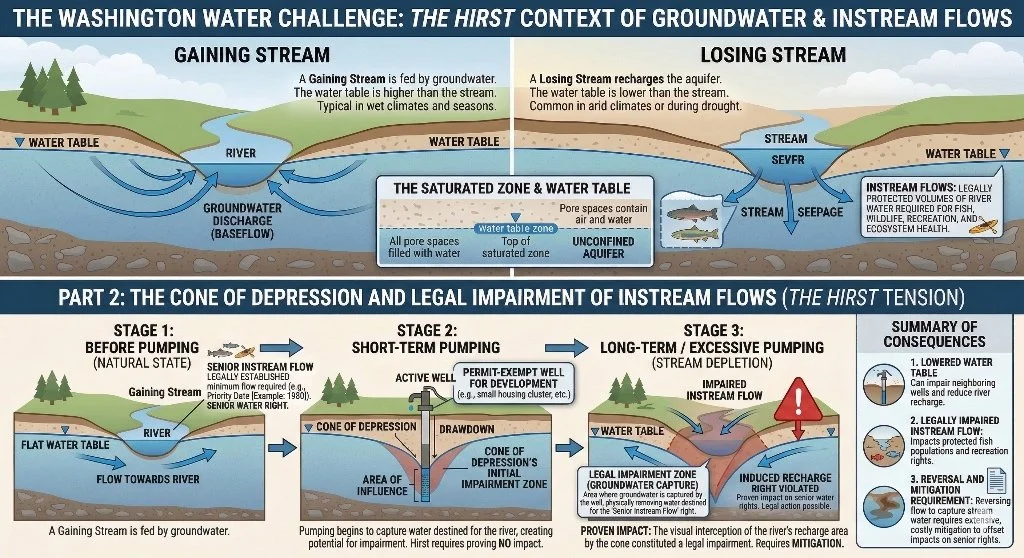
The logic was straightforward: a single household drawing a few thousand gallons a day seemed unlikely to measurably affect a river, and permitting every rural home well would impose enormous administrative burden. But what the 1945 Legislature did not account for — and what science would later confirm — is that groundwater and surface water are hydraulically connected. When a well draws from an unconfined aquifer adjacent to a stream, it reduces the groundwater that would otherwise discharge into that stream. The effect may be small for a single well, but it compounds across hundreds or thousands of wells in a watershed. In basins where instream flows were already at or below minimum levels, the cumulative effect drew water that fish needed, without triggering any legal review.
When Ecology adopted instream flow rules starting in the late 1970s, most of those rules were either silent about permit-exempt wells or explicitly excluded them. Ecology's prevailing interpretation — shared by counties — was that the rules governed permitted water rights, not the exempt category. Wells drilled under the exemption simply did not count against instream flow protections. A series of Washington Supreme Court decisions — particularly Swinomish Indian Tribal Community v. Department of Ecology (2013) and Foster v. Department of Ecology (2015) — progressively tightened legal standards for water availability determinations. The legal ground was shifting beneath the permit-exempt exemption. The question was when the collision would arrive.
Whatcom County v. Hirst — The Collision
The collision came in October 2016. Its epicenter was Whatcom County in northwest Washington, but its shockwave reached every county in the state.
The Nooksack River drains a basin in Whatcom County that has been in water conflict for decades. Ecology adopted the Nooksack Rule — the state's first instream flow rule — in 1985, setting minimum flows for the river to protect fish and wildlife. The Nooksack Rule closed most of the basin to new water right permits, but it was silent on permit-exempt wells. As development in rural Whatcom County accelerated, the county issued building permits for homes relying on permit-exempt wells across the basin — including in areas the Rule had ostensibly closed. Evidence before the Growth Management Hearings Board showed that average minimum instream flows in portions of the Nooksack River were not being met roughly 100 days per year. Despite this, more than 1,600 permit-exempt wells had been drilled in otherwise closed basins since 1997.
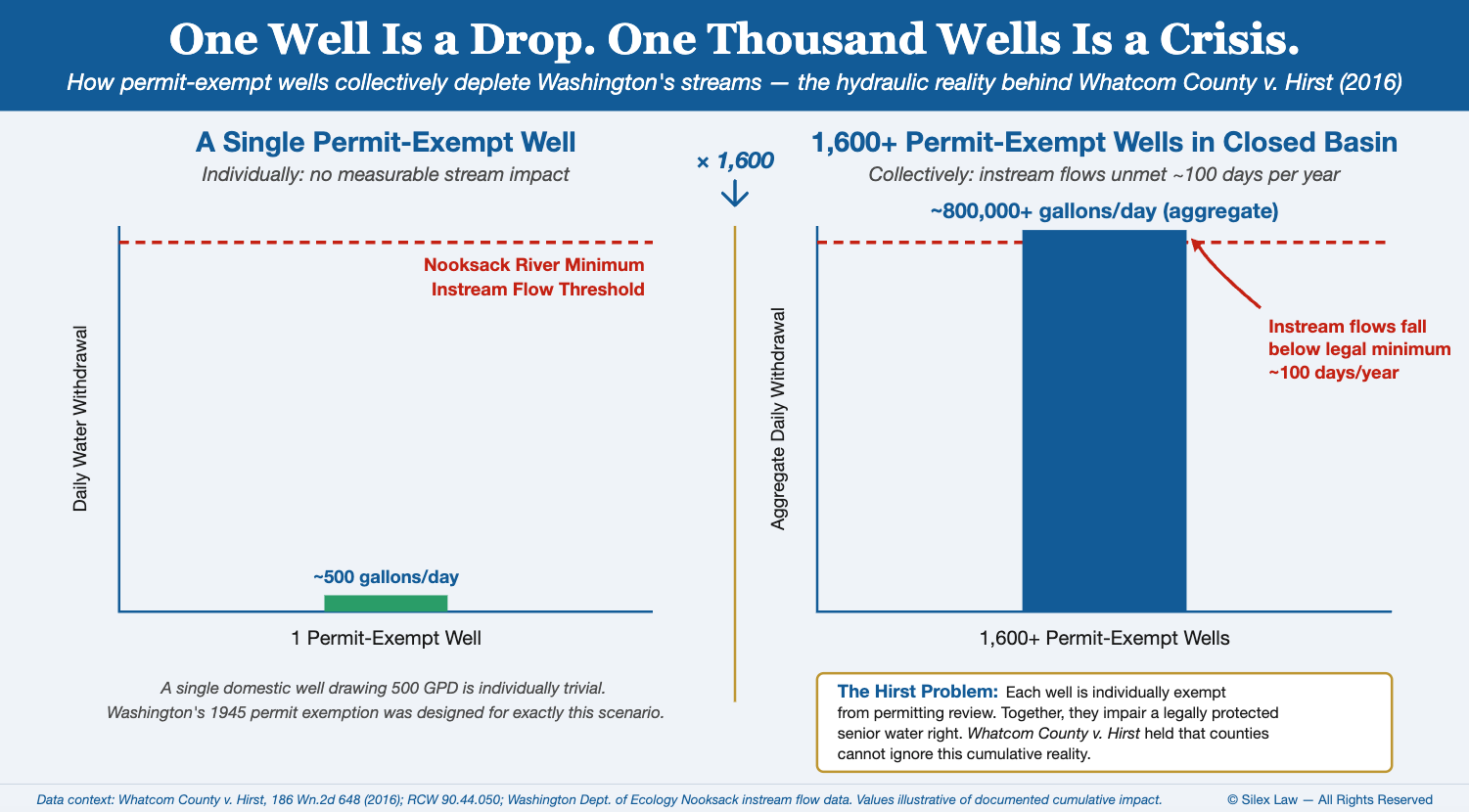
The environmental group Futurewise challenged Whatcom County's approach, arguing that the county's comprehensive plan failed to comply with the Growth Management Act's requirement to protect water resources. The Washington Supreme Court agreed, 6-3, in Whatcom County v. Hirst (October 6, 2016). The Court held that the county could not simply defer to Ecology's Nooksack Rule as establishing water availability, because that rule had not addressed permit-exempt wells. Counties had an independent obligation under the Growth Management Act (GMA) to determine whether water was legally available before issuing building permits. And water is not legally available if a new well would impair a protected river or a senior water right — including an instream flow right.
The majority's reasoning rested on the hydraulic connection science the Court had recognized in prior decisions: groundwater withdrawals can have significant impacts on surface water flows. If a well's cumulative effect reduced streamflow below the minimum instream flow level, the county could not presume water was legally available. Counties would now need affirmative evidence of non-impairment before issuing a permit.
The Hirst majority did not invent a new legal requirement. It applied existing law — prior appropriation, the GMA, and Ecology's own instream flow rules — to a category of water use that had long operated outside their reach.
The immediate consequences were severe. Whatcom County imposed an emergency moratorium on new rural building permits relying on permit-exempt wells. Spokane County, facing similar constraints from the Little Spokane River instream flow rule (WRIA 55), adopted an interim ordinance restricting new development. Counties across western Washington faced the same dilemma: applying the Hirst standard required independent water availability determinations that local building departments had neither the expertise nor the resources to make. The dissent, written by Justice Debra Stephens, warned that the decision had effectively eliminated the permit-exempt category for development purposes — turning a long-settled carve-out into a practical ban on rural home construction.
The 2018 Legislative Response — and Its Limits
The Legislature's answer to Hirst was the Streamflow Restoration Act — a compromise that resolved the political crisis without fully resolving the hydrological one.
In January 2018, Governor Inslee signed Engrossed Substitute Senate Bill 6091, now codified as RCW 90.94 — the Streamflow Restoration Act. The Act restored the core function that Hirst had disrupted: counties could once again issue building permits for homes relying on permit-exempt wells in basins with instream flow rules, without making the independent legal water availability determinations the Supreme Court had required.
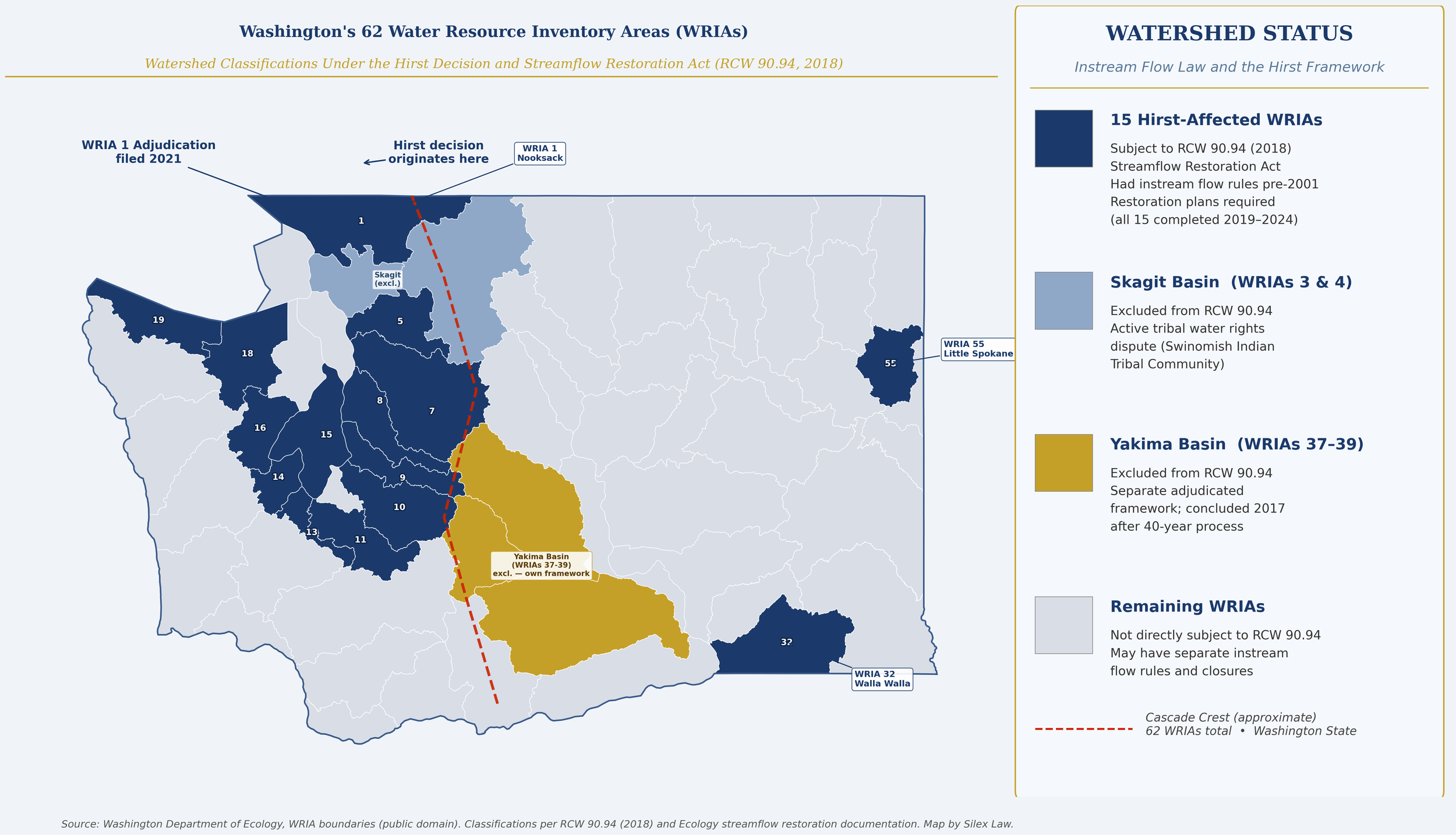
But the Act imposed conditions. It focused on 15 WRIAs that had adopted instream flow rules before 2001 and had been most directly affected by Hirst. In those areas, new permit-exempt wells would be subject to interim volume limits — either 950 gallons per day or 3,000 gallons per day, depending on whether the WRIA had an existing watershed plan — rather than the prior standard of 5,000 gallons per day. A $500 fee would be collected for each building permit; $350 of each fee would flow to Ecology for watershed restoration projects.
Most importantly, the Act directed local planning groups in each affected WRIA to develop watershed restoration plans that estimated the consumptive impacts of new permit-exempt well withdrawals over a 20-year horizon and identified stream enhancement projects sufficient to offset those impacts — achieving a "net ecological benefit" to instream resources. If a planning group failed to produce an approved plan by its deadline, Ecology was required to step in through rulemaking. As of December 2024, Ecology had adopted plans or rules for all 15 WRIAs — but five of them were adopted by Ecology after their local planning groups failed to reach consensus by the statutory deadline.
Two significant exclusions reveal the Act's political limits. The Skagit Basin was excluded because of ongoing tribal rights disputes — specifically the Swinomish Indian Tribal Community's challenge to Ecology's prior attempt to authorize new water uses in a closed basin. The Yakima Basin was excluded because it had its own integrated management framework following its 40-year adjudication. Both exclusions acknowledged that the most contested basins required more than a legislative fix — they required resolution of underlying allocation conflicts that a permit-fee framework could not address.
The Streamflow Restoration Act restored the ability to build homes. It did not restore the water those homes will draw. The Act traded the legal crisis for a planning obligation — and the hydrology has not changed.
Basin Under Pressure — A Statewide Picture
Hirst was decided in Whatcom County, but the conditions that produced it exist in watersheds across the state. Washington's instream flow crisis is not a regional anomaly — it is a statewide pattern wearing different faces in different basins.
The Walla Walla River in southeast Washington represents the historical endpoint of over-appropriation. Agricultural diversions date to the late 1800s. By the mid-20th century, the river was so thoroughly depleted in summer that Ecology's original 1977 instream flow rule did not set a flow level at all — it simply closed the river to further appropriation, acknowledging there was nothing left to protect. Salmon, steelhead, and other native species have suffered dramatic losses as a direct consequence of more than a century of over-allocation. Ecology finally adopted enforceable minimum flows in 2007.
The Yakima Basin presents a more complex and ultimately more hopeful picture. The 6,000-square-mile basin in central and eastern Washington is the state's most important agricultural watershed, producing billions in annual crop revenue. Water conflict there drove Ecology to file a formal adjudication in 1977. That process involved 2,500 water rights across three counties, including the Yakama Nation's tribal claims and tens of thousands of individual irrigators. The adjudication concluded in 2017 after 40 years — and what emerged was a model of what resolution can look like: the Yakama Nation secured its water rights, irrigators received clarity on their allocations, and a cooperative management framework emerged enabling joint investment in water conservation, storage, and habitat improvement.
The Nooksack Basin (WRIA 1) is now where the Yakima Basin was 50 years ago. Ecology filed a formal adjudication of WRIA 1 water rights in 2021 — a process expected to take 10 to 20 years. The Lummi Nation and Nooksack Tribe have been the driving forces behind it. Tribal leaders have been direct: decades of failed negotiation over the basin's water produced over-appropriation, salmon decline, and repeated seasonal streamflow failures. In the meantime, instream flow minimums in parts of the Nooksack go unmet for roughly 100 days a year. The Little Spokane River (WRIA 55) illustrates how Hirst played out in eastern Washington: Spokane County responded to the building permit moratorium by establishing a water bank — purchasing existing senior water rights, retiring them, and offering mitigation certificates to property owners — an innovative mechanism that depends on the continued availability of senior rights for acquisition.
The picture that emerges is not one crisis localized to the northwest corner of the state. It is a statewide pattern: basins where instream flow rules were set decades ago, where over-appropriation of surface water was already established, where permit-exempt wells have continued to draw groundwater without regulatory accounting, and where the legal and hydrological conditions that produced Hirst are present in virtually every watershed that has faced significant development pressure.
Once tribal instream flow rights are formally adjudicated, they rank senior to virtually every other right in the basin. In over-appropriated basins, that seniority determines who gets water in drought years.
The Tribal Dimension — A Floor, Not a Ceiling
For tribes across Washington, instream flow protection is not an environmental preference or a regulatory policy choice. It is a treaty obligation — and the legal analysis that flows from that distinction changes everything.
The Stevens Treaties of 1854 and 1855 reserved to tribal signatories the right to take fish at usual and accustomed places, in common with citizens of the territory. The U.S. Supreme Court has interpreted that right expansively. In Washington v. Washington State Commercial Passenger Fishing Vessel Association (1979), the Court held that the treaty language guarantees tribes not merely access to fishing locations but a share of the harvestable fish. In 2018, the Court affirmed the Ninth Circuit's holding in United States v. Washington (the "Culverts Case") that Washington State violated the Stevens Treaties by building culverts that blocked salmon migration — the right to fish, the Court held, necessarily implies a right to habitat adequate to support fish populations. That principle extends directly to streamflows.
Washington's Yakima River adjudication produced the clearest example of tribal instream flow rights in action. The Yakama Nation secured off-reservation instream flow rights with a "time immemorial" priority date — meaning their right predates every other appropriation in the basin. Those rights are not administrative flow rules subject to legislative modification; they are judicially decreed water rights that the state's prior appropriation system must accommodate.
In most of Washington's unadjudicated basins, this question remains legally open. Ecology's administrative instream flow rules are not tribal treaty rights — the 2018 watershed planning law explicitly recognizes this. However, those rules function to protect senior water rights from impairment, and in practice, protecting instream flows often protects the habitat on which tribal fishing rights depend. The Nooksack adjudication will test how far that protection extends: the Lummi Nation and Nooksack Tribe have asserted treaty-based instream flow rights across the basin, including off-reservation reaches. One of the most significant unresolved questions in Washington water law — whether Stevens Treaty tribes hold enforceable instream flow water rights with time-immemorial priority in unadjudicated basins — will be decided in Whatcom County Superior Court over the coming decade.
Once tribal instream flow rights are formally adjudicated, they rank senior to virtually every other right in the basin. In over-appropriated basins, that seniority determines who gets water in drought years.
These questions connect directly to a broader set of issues about what the Stevens Treaties require of the state in a warming, water-stressed future — the central subject of a separate Silex Law educational page on Stevens Treaty water rights.
The Climate Multiplier — A Legal Problem Becomes a Physical One
Washington's instream flow crisis developed over decades as the product of legal choices. Climate change is converting a legal problem into a physical one.
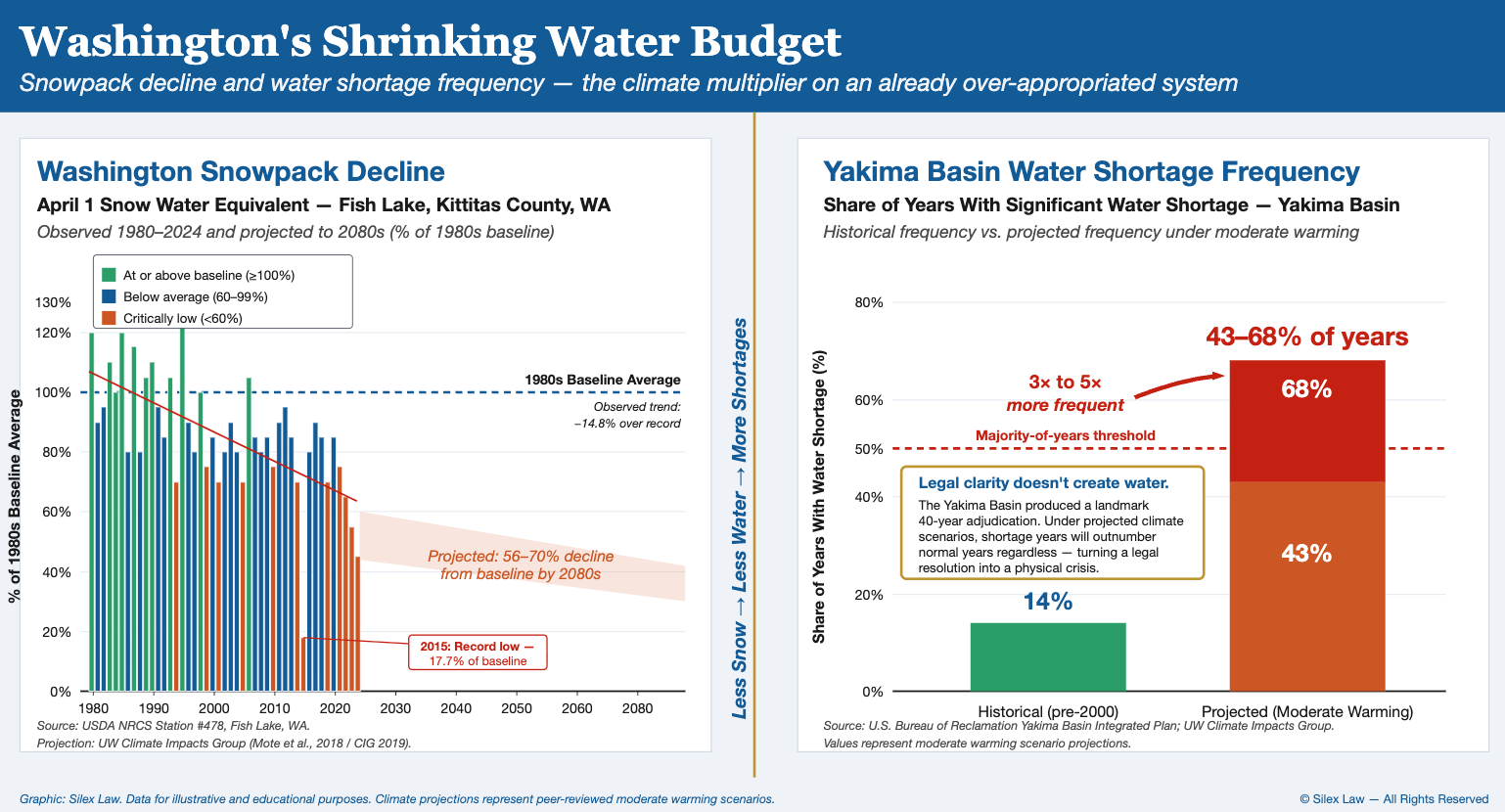
Washington's water supply depends heavily on snowpack. The mountains store winter precipitation as snow and release it gradually through spring and summer, sustaining streamflows during the warmest and driest months — exactly when fish need cold water, when crops need irrigation, and when domestic wells draw most heavily. That natural storage system is declining. Statewide, the amount of precipitation falling as snow has decreased roughly 16 percent since 1949, and average freezing elevations have risen nearly 900 feet. Scientists project that average spring snowpack will decline by 56 to 70 percent by the 2080s under moderate warming scenarios.
The Yakima Basin illustrates the magnitude of the shift. Historically, water shortage years — years in which water delivery to junior rights holders is curtailed — occurred roughly 14 percent of the time. Under projected climate scenarios, that frequency is expected to increase to 43 to 68 percent of years. Even with the legal clarity produced by 40 years of adjudication, the basin faces a future in which water shortages are more the rule than the exception.
Climate change does not create over-appropriation — that condition predates it by decades in most affected basins. But it accelerates and deepens the consequences. In basins where instream flows were barely being met under historical conditions, reduced snowpack and earlier melt push those flows further below minimums for longer periods of the summer. Junior rights holders face more frequent curtailment. Tribes face greater threat to the salmon populations their treaty rights depend on. Rural homeowners with permit-exempt wells draw groundwater that connects to streams already in deficit. The Streamflow Restoration Act's 20-year planning horizon reflects recognition that these problems compound over time — but actual appropriations for the $300 million restoration commitment have lagged, and the gap between the legal framework and physical reality continues to widen.
Three Pathways Forward — A Silex Analysis
Washington's instream flow problem does not resolve through any single mechanism. Three distinct pathways are operating in parallel — each with its own timeline, its own actors, and its own capacity to produce durable solutions.
The first pathway is formal adjudication. An adjudication is a court-supervised proceeding that determines the legal status, quantity, and priority of every water right in a basin — including groundwater, surface water, tribal rights, instream flow rights, and permit-exempt wells. Adjudication is the most comprehensive mechanism available: it produces legally binding, judicially decreed water rights that cannot be overridden by subsequent legislation or administrative interpretation. Its costs are also the most significant. The Yakima adjudication consumed 40 years and enormous resources. The Nooksack, projected to take 10 to 20 years, will resolve the fundamental question of tribal instream flow rights in that basin — but it will not be swift.
The second pathway is legislative and regulatory intervention. The Streamflow Restoration Act of 2018 is the most recent example: legislation that rebalanced competing interests, established new planning requirements, and directed state investment in restoration. Future legislation could expand the fee structure, strengthen enforcement mechanisms, address the gap between permit-exempt impacts and restoration project timelines, or extend the metering pilot programs to additional basins. Regulatory action by Ecology — updating instream flow rules, expanding monitoring, or establishing new basin-specific standards — can move faster than legislative cycles but is subject to legal challenge and political resistance.
The third pathway is negotiated basin management — the cooperative model the Yakima Basin now exemplifies. Following adjudication, the Yakama Nation, irrigation districts, federal agencies, and the state entered a collaborative framework enabling joint investment in water conservation infrastructure, storage, and habitat improvement. That cooperative environment was not achievable before adjudication settled the underlying allocation disputes. In basins where adjudication is not imminent, voluntary water markets — including water banking and trust water rights programs — provide limited but meaningful tools for shifting water from consumptive uses to instream flows.
The Yakima Basin took 40 years and produced results. The question for every other over-appropriated basin in Washington is whether the state has 40 years to spend — and whether the salmon do.
For landowners, developers, water users, tribal nations, and practitioners across Washington, the instream flow landscape is active and consequential. The legal rules governing permit-exempt wells, the planning obligations under RCW 90.94, the adjudications underway in WRIA 1 and WRIA 58, and the tribal water rights questions moving through the courts will collectively reshape the state's water allocation system over the coming decades. Silex Law monitors these developments across its Water Law Decisions and Water Legislation Watch blog series.
Additional Resources
Primary Legal Sources
RCW 90.22 — Minimum Water Flows and Levels Act (1969) — The statute authorizing Ecology to establish instream flow rules as enforceable water rights.
RCW 90.54 — Water Resources Act of 1971 — Recognized instream flows, fish and wildlife habitat, and aesthetic values as beneficial uses of water equal in legal status to consumptive uses; established the 62 WRIA framework.
RCW 90.44.050 — Groundwater Permit Exemption — The 1945 statute creating the permit-exception well category at the center of the Hirst dispute.
RCW 90.94 — Streamflow Restoration Act (2018) — The Legislature's response to Hirst; established the 15-WRIA restoration planning framework, permit conditions, and the $500 fee structure.
Whatcom County v. Hirst, 186 Wn.2d 648 (2016) — The Washington Supreme Court decision holding that counties bear an independent duty to determine water availability under the GMA before issuing permits for homes relying on permit-exempt wells.
Foster v. Dep’t of Ecology, 184 Wn.2d 465 (2015) — Prohibited out-of-kind mitigation; tightened legal standards for water availability determinations in basins with instream flow rules.
Swinomish Indian Tribal Community v. Dep’t of Ecology, 178 Wn.2d 571 (2013) — Invalidated Ecology's use of the overriding public interest exception to authorize new water rights in a basin closed by instream flow rule.
Washington v. Washington State Commercial Passenger Fishing Vessel Assn, 443 U.S. 658 (1979) — The U.S. Supreme Court decision confirming that Stevens Treaty fishing rights guarantee tribes a share of harvestable fish, not merely access to fishing locations.
United States v. Washington (Culverts Case), 584 U.S. 23 (2018) — U.S. Supreme Court affirmance establishing that Washington's culvert-building program violated the Stevens Treaties by blocking salmon migration; the right to fish implies a right to habitat adequate to support fish populations.
Washington State Department of Ecology
Hirst Decision Resource — Ecology's primary page for the Hirst decision, including agency response documentation and water availability guidance.
Streamflow Restoration — WRIA Planning Status — Ecology's central hub for the 15-WRIA restoration planning process, including individual WRIA plan documents and Ecology-adopted rules for the five basins whose local groups missed the statutory deadline.
Instream Flow Implementation — Basin-by-basin instream flow implementation resources, including water availability focus sheets for all 62 WRIAs.
Adjudication & Tribal Resources
Whatcom County Public Works — WRIA 1 Adjudication Resources — County-maintained resource page for the ongoing Nooksack Basin adjudication, including a water rights glossary and process overview.
Northwest Treaty Tribes — Nooksack Adjudication — The Northwest Indian Fisheries Commission's coverage of the WRIA 1 adjudication and the tribal water rights interests it involves.
Climate & Water Supply
University of Washington Climate Impacts Group — Washington-specific climate projections including snowpack decline, streamflow timing shifts, and the Climate Mapping for a Resilient Washington interactive tool.
State of Salmon in Washington — Climate Change — Joint state agency resource on the intersection of climate change, streamflow, and salmon habitat.
Policy Analysis & Legislative History
MRSC — Legislature Addresses Hirst v. Watcom County (Jan. 2018) — The Municipal Research and Services Center's overview of SB 6091's legislative history, the key compromises that produced the final bill, and county-level implementation implications.
Center for Environmental Law & Policy — History of WA Water Law — Narrative overview of Washington water law development from territorial period through modern instream flow doctrine.
Haylee J. Hurst, “Changing Course: Revisiting Instream Flow Rulemaking in Washington State Following Swinomish v. Ecology,” 90 Washington Law Review 1901 (2015) — Scholarly analysis of how Swinomish and Foster constrain Ecology's rulemaking authority and the case for best-available-science standards.
For ongoing developments related to Washington instream flow law — including the WRIA 1 adjudication, Ecology rulemaking updates, watershed restoration plan status, and tribal water rights litigation — see the Water Law Decisions and Water Legislation Watch blogs.