
The Stevens Treaties
Fishing Rights, Water Rights, and the Legal Architecture of the Pacific Northwest Indian Law
In the winter of 1854 and the spring and summer of 1855, Isaac Ingalls Stevens — the first governor of Washington Territory and its superintendent of Indian affairs — convened a series of treaty councils with the Indigenous peoples of the Pacific Northwest. By the time the negotiations concluded in October 1855, Stevens had reached eight agreements with dozens of tribes and bands spanning western Washington, the Columbia Plateau, and western Montana. Those agreements — collectively known as the Stevens Treaties — remain among the most litigated and consequential Indian law documents in American history.
The treaties followed a template. Each nation ceded vast territories to the United States, retaining small reservations. In return, they received promises of annuities, schools, and trade goods. But the most durable provisions were the ones that reserved rights the tribes had never surrendered — above all, the right to fish at all their usual and accustomed grounds and stations, secured to them in common with the citizens of the territory. Those words, drafted by Stevens and accepted by tribal leaders who understood them through their own legal and cultural frameworks, have been the subject of federal litigation ever since. They are also the legal foundation for some of the most senior water rights in the Pacific Northwest.
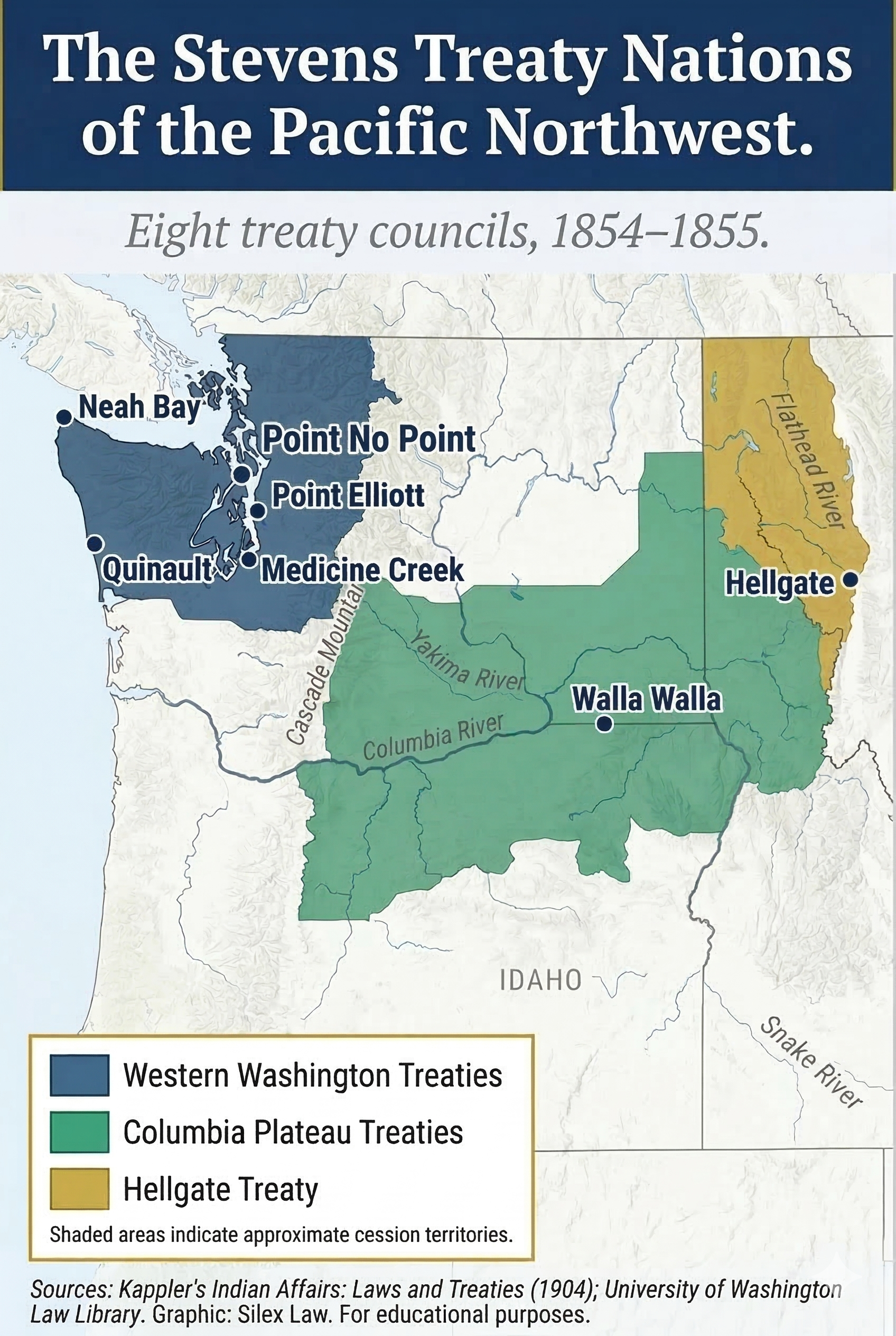
The eight Stevens Treaty councils of 1854–1855 established reserved fishing, hunting, and gathering rights across three distinct geographic regions: western Washington and the Olympic Peninsula, the Columbia Plateau, and western Montana. The shaded areas indicate approximate cession territories — the lands tribes conveyed to the United States while retaining the rights that federal courts have been interpreting ever since. Sources: Kappler's Indian Affairs: Laws and Treaties (1904); University of Washington Law Library. Graphic: Silex Law. For educational purposes.
The Treaties and the Tribes
Stevens concluded eight treaties between December 1854 and October 1855. The first six addressed tribes west of the Cascade Mountains and on the Olympic Peninsula; the remaining two addressed Plateau and Mountain peoples east of the Cascades and into Montana. Each treaty was formally bilateral — the United States on one side, a named tribal group or confederation on the other — but the practical dynamics of the negotiations were not equal. Many tribal leaders understood only portions of what they were signing through hurried translation, and Stevens operated under explicit pressure to minimize the number of reservations and hold costs low.
The western Washington treaties — Medicine Creek (1854), Point Elliott (1855), Point No Point (1855), Neah Bay (1855), and Olympia/Quinault (1855/1856) — addressed Coast Salish, Lushootseed, and Chimakuan peoples across Puget Sound and the Olympic Peninsula. Medicine Creek, signed first at the southern end of Puget Sound on December 26, 1854, brought in the Nisqually, Puyallup, Steilacoom, Squaxin Island, and related bands. Point Elliott, signed near present-day Mukilteo, carried the marks of representatives of fifteen tribes and bands including the Duwamish, Suquamish, Lummi, Skagit, and others — among them Chief Seattle of the Duwamish and Suquamish. Point No Point covered the S'Klallam, Skokomish, and Chimakum. Neah Bay was the treaty of the Makah, who retained a specific right to take whales in addition to the standard fishing clause. The Quinault Treaty addressed the Quinault and Quileute peoples of the outer Olympic coast.
East of the Cascades, the Walla Walla Council of June 1855 produced three separate agreements. The Yakama Treaty brought together fourteen bands and tribes of the Columbia Plateau under the confederated name Yakama, under the leadership of Kamiaakun. The Umatilla Treaty addressed the Walla Walla, Cayuse, and Umatilla, who were reserved lands in what is now northeastern Oregon. The Nez Perce Treaty secured a large reservation spanning southeastern Washington, northeastern Oregon, and northern Idaho — the most expansive reservation established by the Stevens process and the homeland of a people whose subsequent history became one of the defining tragic narratives of the American West.
The Treaty of Hellgate (1855), negotiated with the Flathead, Kalispel (Pend d'Oreille), and Kutenai peoples of western Montana, completed the Stevens treaty sequence and established the Flathead Reservation in Montana. Stevens also concluded a treaty with the Blackfoot Confederation at the confluence of the Judith River in present-day Montana, though that agreement differed in that it set no reservation and focused on peace and trade rather than land cession.
Not every tribe in the region signed a Stevens Treaty. Several nations received reservations established by executive order rather than ratified treaty, with legal consequences for their rights claims that persist in ongoing adjudications today.
The Fishing Clause and What the Tribes Reserved
The operative language of the fishing clause appears in nearly identical form across the western Washington and Columbia Plateau treaties. The most frequently cited version comes from Article III of the Yakama Treaty:
"The exclusive right of taking fish in all the streams, where running through or bordering said reservation, is further secured to said confederated tribes and bands of Indians, as also the right of taking fish at all usual and accustomed places, in common with citizens of the Territory, and of erecting temporary buildings for curing them; together with the privilege of hunting, gathering roots and berries, and pasturing their horses and cattle upon open and unclaimed lands."
The phrase "in common with citizens of the Territory" became the most contested language in the history of Pacific Northwest Indian law. The state of Washington read it as a limitation — tribes shared the fishery equally with everyone else, taking their proportionate share as one group among many. The tribes read it as a recognition of a pre-existing right — a right that the tribes had always held and that the treaty merely confirmed, while extending a concurrent right to settlers. That interpretive dispute was the central question in United States v. Washington more than a century later.
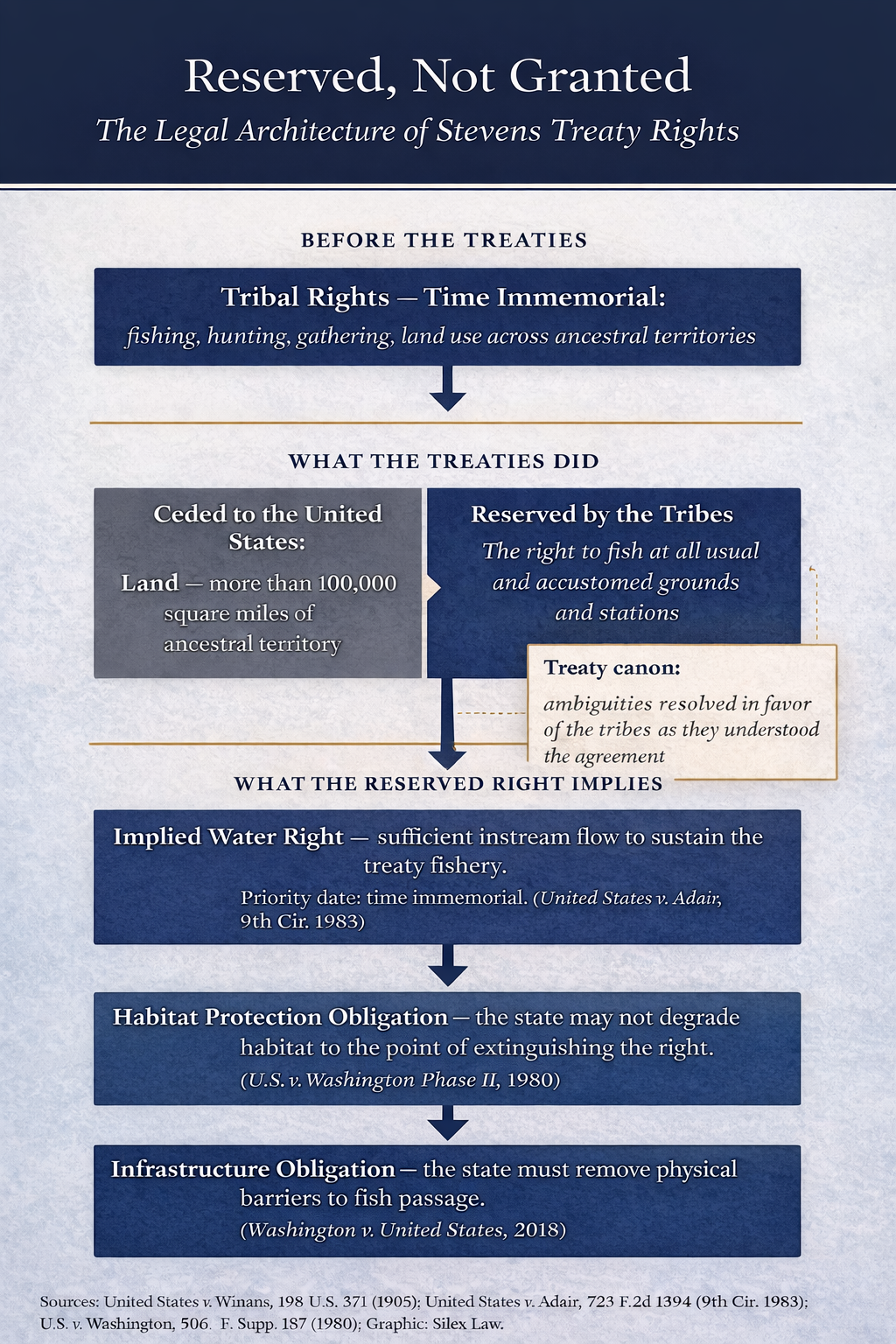
The canon of construction that courts apply to Indian treaties reinforces the tribal reading. When treaty language is ambiguous, courts construe it as the tribe would have understood it at the time of signing — not as the United States drafters may have intended. Because the treaty was drafted in English by Stevens' team and explained to tribal leaders through rushed translation, any ambiguity resolves in favor of the tribe. Applied to the fishing clause, that canon consistently supports the conclusion that the tribes did not receive a right from the United States — they reserved a right they had always held, granting to settlers only a concurrent share.
Equally important is what the treaties did not say. The tribes did not reserve fishing rights and water rights as separate categories. They reserved a right to fish. The water rights necessary to make that fishing right meaningful were implied by the reservation itself. A right to fish at a usual and accustomed place that has run dry carries no practical content. That implication is where the connection between the Stevens Treaty fishing clause and Pacific Northwest water law originates.
The Stevens Treaties did not grant fishing rights to the tribes — the tribes reserved rights they already held, conveying land to the United States while retaining the right to fish at all usual and accustomed grounds and stations. Courts applying the canon of construction resolve ambiguities in treaty language in favor of the tribes as they understood the agreement. That reserved fishing right carries with it an implied water right sufficient to sustain the fishery, a state obligation against habitat destruction, and a duty to remove physical barriers to fish passage. Sources: United States v. Winans, 198 U.S. 371 (1905); United States v. Adair, 723 F.2d 1394 (9th Cir. 1983); U.S. v. Washington, 506 F. Supp. 187 (W.D. Wash. 1980). Graphic: Silex Law. For educational purposes.
United States v. Winans and the First Federal Affirmation
The first significant test of the Stevens Treaty fishing rights came not from a fishing access dispute in Puget Sound but from a fish wheel on the Columbia River. Audubon and Linnaeus Winans held state licenses to operate fish wheels — mechanical devices that continuously scooped salmon from the river — at Celilo Falls, one of the most productive and culturally significant fishing sites in the Pacific Northwest. The wheels were so efficient that they effectively captured the run before tribal fishermen upstream could reach it. The Winans brothers also fenced off the riverbank, physically blocking tribal members from reaching the shoreline at their accustomed stations.
The United States, acting as trustee for the Yakama Nation, sued. In United States v. Winans, 198 U.S. 371 (1905), the Supreme Court held that the Yakama Treaty fishing right was not extinguished by state licensing of the Winans' operations, and that the tribe's right of access to usual and accustomed fishing places — including crossing private land to reach the river — was an easement running against subsequent landowners. The Court articulated the principle that would anchor all subsequent Stevens Treaty interpretation: the treaty was not a grant of rights to the Indians, but a grant of rights from the Indians, reserving those not granted.
Winans established that treaty fishing rights are property rights under federal law that survive state action and run with the land. It did not resolve how much fish the tribes were entitled to, what authority the state retained to regulate tribal fishing, or whether the state could effectively extinguish the right by regulating the overall fishery to the point that no fish remained. Those questions required another seven decades and the most consequential Indian law decision of the twentieth century.
United States v. Washington — The Boldt Decision
By the 1960s, the State of Washington had spent decades managing the salmon fishery in ways that progressively excluded tribal fishermen from exercising their treaty rights. The state applied its fishing regulations to tribal members, closed tribal fishing stations, and allocated the harvest to commercial and sport fishermen without accounting for the tribes' prior claim to the resource. By 1970, tribal members took less than five percent of the total salmon harvest in Washington waters — a fraction of what their treaties had promised.
The Fish Wars of the 1960s and early 1970s brought the conflict into public view. Tribal members, many of them from the Nisqually, Puyallup, and Muckleshoot tribes, conducted protest fish-ins on the Nisqually and Puyallup rivers in the manner of civil rights demonstrations — fishing in assertion of their treaty rights, accepting arrest, and drawing media attention to the gap between legal entitlement and operational reality. Billy Frank Jr. of the Nisqually Tribe was arrested more than fifty times beginning when he was fourteen years old. The federal government, watching the protests and facing its own trust responsibility to the tribes, filed suit against the state in 1970.
The case was assigned to U.S. District Judge George H. Boldt of the Western District of Washington. On February 12, 1974, after three years of preparation, testimony from approximately fifty witnesses, and review of 350 exhibits, Boldt issued his decision in United States v. Washington, 384 F. Supp. 312 (W.D. Wash. 1974).
The holding turned on the phrase "in common with." Boldt reviewed the minutes of the treaty negotiations — what Stevens' translators actually told tribal leaders the language meant — and found that the United States had represented to the tribes that they would share the fish resource equally with settlers. "In common with" was not a limitation on a tribal right; it was a commitment to equal sharing. On that basis, Boldt held that the treaty tribes were entitled to take up to fifty percent of the harvestable salmon and steelhead that passed through their usual and accustomed areas — calculated run by run and river by river.
The decision made the tribes co-managers of the fishery alongside the state. Neither the state nor the tribes had a structure in place for that arrangement. Nineteen treaty tribes suddenly held co-management authority over Washington's commercial and sport fisheries, requiring the hiring of fish biologists, the development of harvest management plans, and the creation of tribal fisheries programs that had not previously existed. The state's commercial fishermen faced immediate, severe reductions in their allowable catch, and the backlash was significant. Judge Boldt was burned in effigy outside the federal courthouse. The state of Washington undertook what the Ninth Circuit later described as extraordinary machinations in resisting the decree.
The Ninth Circuit affirmed the Boldt decision in 1975. The U.S. Supreme Court declined to hear the case on initial appeal. After continued state resistance, the Supreme Court addressed the matter directly in Washington v. Washington State Commercial Passenger Fishing Vessel Association, 443 U.S. 658 (1979), affirming the core of Boldt's ruling. Justice John Paul Stevens wrote that both sides had a right, secured by treaty, to take a fair share of the available fish. The Court endorsed the use of federal law enforcement, including the Coast Guard, to enforce compliance. The treaty right to half the harvestable catch was settled federal law.
The tribes became effective participants in the fishery within a decade. By 1984, treaty tribes were taking forty-nine percent of the Puget Sound harvest. The Makah, acting under the Neah Bay Treaty's explicit whaling provision — the only Stevens Treaty to include one — exercised a treaty-reserved right to take a gray whale in 1999, the first such harvest in more than seventy years.
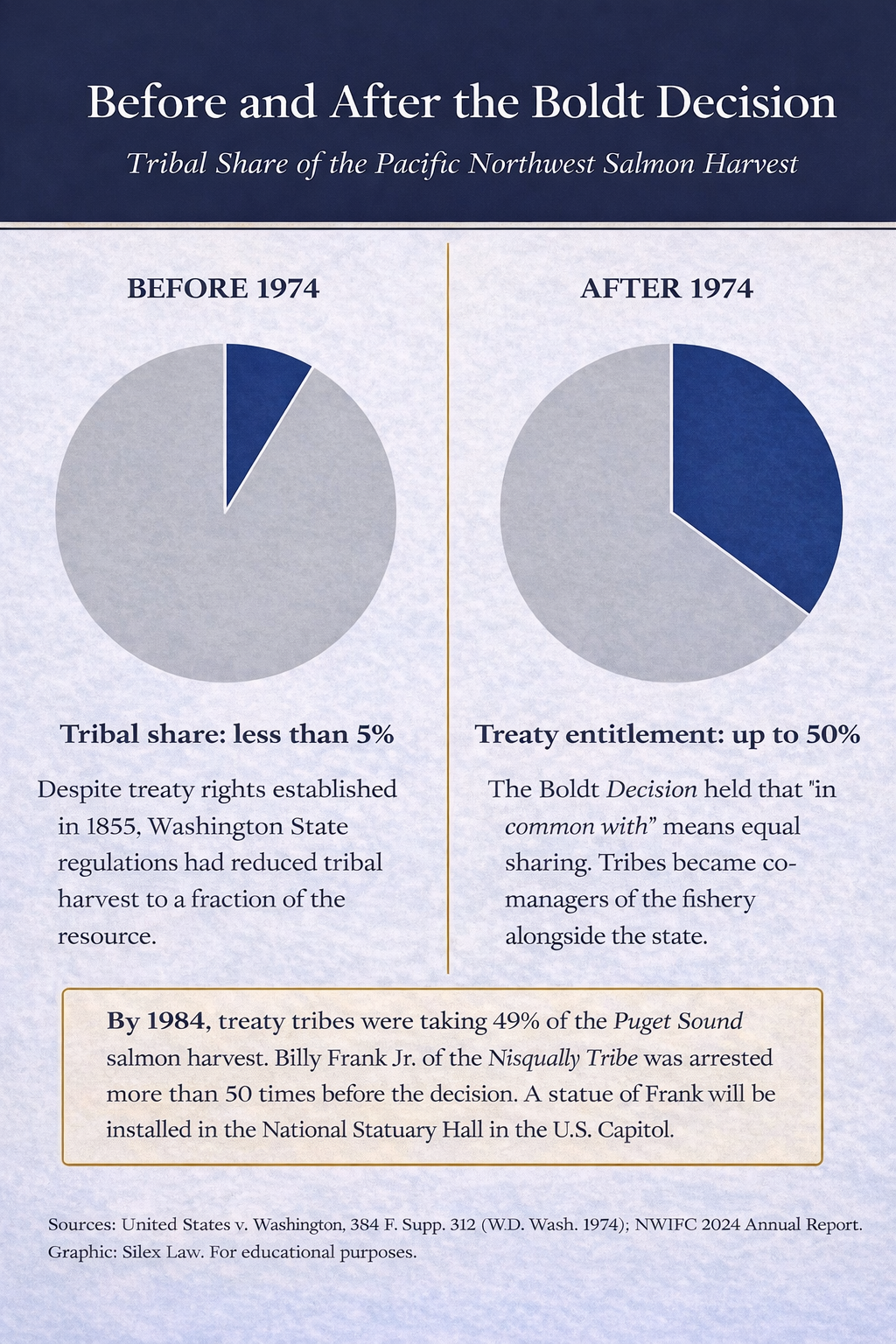
Before the 1974 Boldt Decision, treaty tribes took less than five percent of the Pacific Northwest salmon harvest despite holding legal rights established in 1855. Judge George Boldt held that "in common with" meant equal sharing, entitling treaty tribes to up to fifty percent of the harvestable salmon passing through their usual and accustomed areas. By 1984, treaty tribes were taking forty-nine percent of the Puget Sound harvest. The decision also made tribes co-managers of the fishery alongside the State of Washington — an institutional role they have exercised ever since. Sources: United States v. Washington, 384 F. Supp. 312 (W.D. Wash. 1974); NWIFC 2024 Annual Report. Graphic: Silex Law. For educational purposes.
The Water Right Implied by the Treaty
The Boldt decision resolved the allocation question — how much fish the tribes were entitled to take. It did not directly address the water right necessary to make that entitlement operational. A right to fifty percent of the harvestable salmon is meaningful only if there are salmon to harvest. And salmon exist only where there is adequate water in adequate condition — sufficient stream flow to allow upstream migration, suitable temperatures for spawning and rearing, and enough volume to maintain productive habitat.
The connection between treaty fishing rights and water rights runs through the Winters doctrine. When the federal government established Indian reservations, it impliedly reserved, by operation of federal law, sufficient water to fulfill the reservation's purpose. For reservations whose primary purpose included sustaining a fishing-based way of life — as the Stevens Treaty reservations explicitly did — the implied water right encompasses not just water for agriculture or domestic use but water sufficient to support the fishery itself.
The Ninth Circuit addressed this principle directly in United States v. Adair, 723 F.2d 1394 (9th Cir. 1983), a case involving the Klamath Tribe's treaty rights in Oregon. The court held that the tribe's right to hunt and fish on the reservation — secured by an 1864 treaty — carried an implied water right sufficient to maintain the stream flows necessary to support that fishery. Critically, the Adair court held that the priority date of that water right was time immemorial — predating every other water user in the basin by the full span of the tribe's occupancy of the land. That priority date reflects the same logic the Boldt decision applied to fishing allocation: the tribes did not receive these rights; they reserved them.
Applied to the Stevens Treaty tribes of Washington, the Adair principle means that treaty tribes hold implied water rights — with priority dates from time immemorial or the date of reservation establishment — sufficient to maintain the instream flows necessary to support their treaty fisheries. Those rights are senior to every state-law water right in the rivers where they apply. They do not require diversion, beneficial use in the prior appropriation sense, or any administrative filing under state law. And they cannot be extinguished except by act of Congress.
Washington State's water law has not formally quantified these rights in most river systems. The Yakima Basin adjudication — a general stream adjudication covering all water rights in the Yakima Basin — has been ongoing in Yakima County Superior Court since 1977 and has produced partial determinations but not a comprehensive final decree. Similar adjudications are underway or pending in other Washington watersheds. Until those proceedings reach final resolution, the full scope of Stevens Treaty water rights in Washington operates as a large, senior, and formally unquantified prior claim on the resource — a structural feature of the state's water law that every water manager and developer must account for.
The Hirst decision and Washington's surface water / groundwater conflict illustrate how that dynamic plays out in practice. When the Washington Supreme Court held in Whatcom County v. Hirst (2016) that permit-exempt wells could affect senior water rights, the senior rights in question included tribal treaty rights to instream flows in Hirst-affected Water Resource Inventory Areas. The Legislature's 2018 response — establishing mitigation frameworks and limiting courts' ability to require case-by-case hydrogeological showings — addressed the administrative impasse but did not resolve the underlying legal question of what instream flow protections the treaty obligation requires. That question remains live and will become more pressing as snowpack declines reduce summer streamflows across the Pacific Northwest. The instream flow and Hirst crisis is addressed in detail in the Educate Yourself page on Washington State Instream Flows and the Hirst Crisis.
Phase II — The Right Against Habitat Destruction
Judge Boldt structured United States v. Washington into two phases. Phase I addressed the allocation question — what share of the fish the tribes were entitled to take. Phase II addressed a harder question: whether the treaty right included not just the right to harvest fish but a right to have the habitat that produces those fish protected from degradation.
In 1980, U.S. District Judge William Orrick took up Phase II and issued a decision that extended the treaty right significantly. In United States v. Washington (Phase II), 506 F. Supp. 187 (W.D. Wash. 1980), Judge Orrick held that if state-created environmental damage — urbanization, logging, water diversion — were allowed to destroy the salmon habitat until no fish remained, the right to take fish would be reduced to the right to dip a net into an empty river. The treaty right, he reasoned, must carry with it a right against such man-made despoliation. He also held that hatchery-produced fish must be counted in the tribes' harvest share — a ruling with significant operational consequences as Washington's salmon runs increasingly depended on hatcheries rather than wild spawning.
The Ninth Circuit vacated the environmental holding in 1985, ruling en banc that the legal standards governing the state's habitat obligations would depend on the specific facts of individual disputes. Phase II's habitat right was real in principle but required case-by-case development.
That case-by-case development arrived in 2001, when twenty-one tribes invoked the district court's continuing jurisdiction to challenge Washington's construction and maintenance of culverts — drainage structures under state roads that blocked salmon migration. Barrier culverts prevent adult salmon from reaching upstream spawning habitat and prevent juveniles from reaching the ocean to mature, effectively cutting off miles of productive stream habitat from the fishery. The tribes argued that the state's culverts violated the treaty by depriving them of their treaty share of the salmon those streams would have supported.
The district court agreed, and in 2013 issued an injunction ordering Washington to replace state-owned barrier culverts that block significant salmon habitat by 2030 — at an estimated cost of several billion dollars. The Ninth Circuit affirmed unanimously in 2016. The State of Washington appealed to the U.S. Supreme Court, which in 2018 issued a one-sentence order: the judgment is affirmed by an equally divided court. With Justice Kennedy recused, the eight remaining justices split four to four, leaving the Ninth Circuit's ruling and the district court's injunction in place without a majority opinion.
The culverts decision is the current operational frontier of Phase II. Washington must continue replacing barrier culverts, the scope of the obligation is confirmed by the court of last resort, and the question of what other forms of habitat degradation the treaty right constrains remains open. Climate change is already beginning to push that question forward. Tribal leaders have argued that the treaty right to a productive fishery extends to state obligations around temperature, stream flow, and watershed management — that the treaty is not merely a historical document fixing rights in 1855 but a living obligation that the state must honor as conditions change. No court has yet fully addressed that argument, but the Phase II litigation's logic does not foreclose it.
The Treaty Tribes and Their Institutions
The Stevens Treaties did not merely establish legal rights — they eventually produced an institutional architecture for exercising those rights. That architecture did not exist in 1855, and it did not emerge from the treaties themselves. It was built in the aftermath of the Boldt decision, when tribes across the Pacific Northwest needed mechanisms to act as co-managers of shared fisheries and to coordinate their legal positions with state and federal agencies. Because the treaties covered three distinct geographies — western Washington, the Columbia Plateau, and western Montana — the tribes organized through three separate institutions, each reflecting the resource system its member tribes fish.
Northwest Indian Fisheries Commission (NWIFC)
The Northwest Indian Fisheries Commission was established in 1974 in direct response to the Boldt decision. When Judge Boldt designated nineteen treaty tribes in western Washington as co-managers of the state's salmon and steelhead fisheries, neither the tribes nor the state had a structure in place to exercise that joint authority. The NWIFC was created to fill that gap — to provide centralized scientific, legal, and management support to tribes that individually lacked the staff capacity to operate as full co-managers of a complex, multi-species commercial fishery.
The commission today serves twenty member tribes: the Lummi Nation, Nooksack Tribe, Swinomish Indian Tribal Community, Upper Skagit Indian Tribe, Sauk-Suiattle Indian Tribe, Stillaguamish Tribe, Tulalip Tribes, Muckleshoot Indian Tribe, Puyallup Tribe of Indians, Nisqually Indian Tribe, Squaxin Island Tribe, Skokomish Indian Tribe, Suquamish Tribe, Port Gamble S'Klallam Tribe, Jamestown S'Klallam Tribe, Lower Elwha Klallam Tribe, Makah Tribe, Quileute Indian Tribe, Quinault Indian Nation, and Hoh Indian Tribe. All twenty are parties to one or more of the five western Washington Stevens Treaties — Medicine Creek, Point Elliott, Point No Point, Neah Bay, or Olympia/Quinault — and all hold off-reservation fishing rights in Puget Sound, the Washington coast, or both.
The NWIFC's member tribes have produced some of the most significant treaty rights developments since the Boldt decision. The Lummi Nation successfully blocked construction of a major coal export terminal at Cherry Point in 2016, convincing the Army Corps of Engineers that the terminal would destroy treaty-protected shellfish beds — extending treaty protection into the infrastructure permitting context in a way that has since been widely cited. The Lower Elwha Klallam Tribe's treaty fishing rights on the Elwha River were effectively destroyed when the Elwha and Glines Canyon Dams were built in the early twentieth century without tribal consent; after decades of advocacy, Congress authorized removal of both dams in 1992, and their physical removal between 2011 and 2014 — the largest dam removal project in American history — was driven in substantial part by the tribe's treaty claim to a restored fishery. The Makah Tribe, whose Neah Bay Treaty contains the only explicit treaty-reserved whaling right in the United States, exercised that right in 1999 for the first time in over seventy years and continues to seek federal authorization for a limited ceremonial hunt under the Marine Mammal Protection Act.
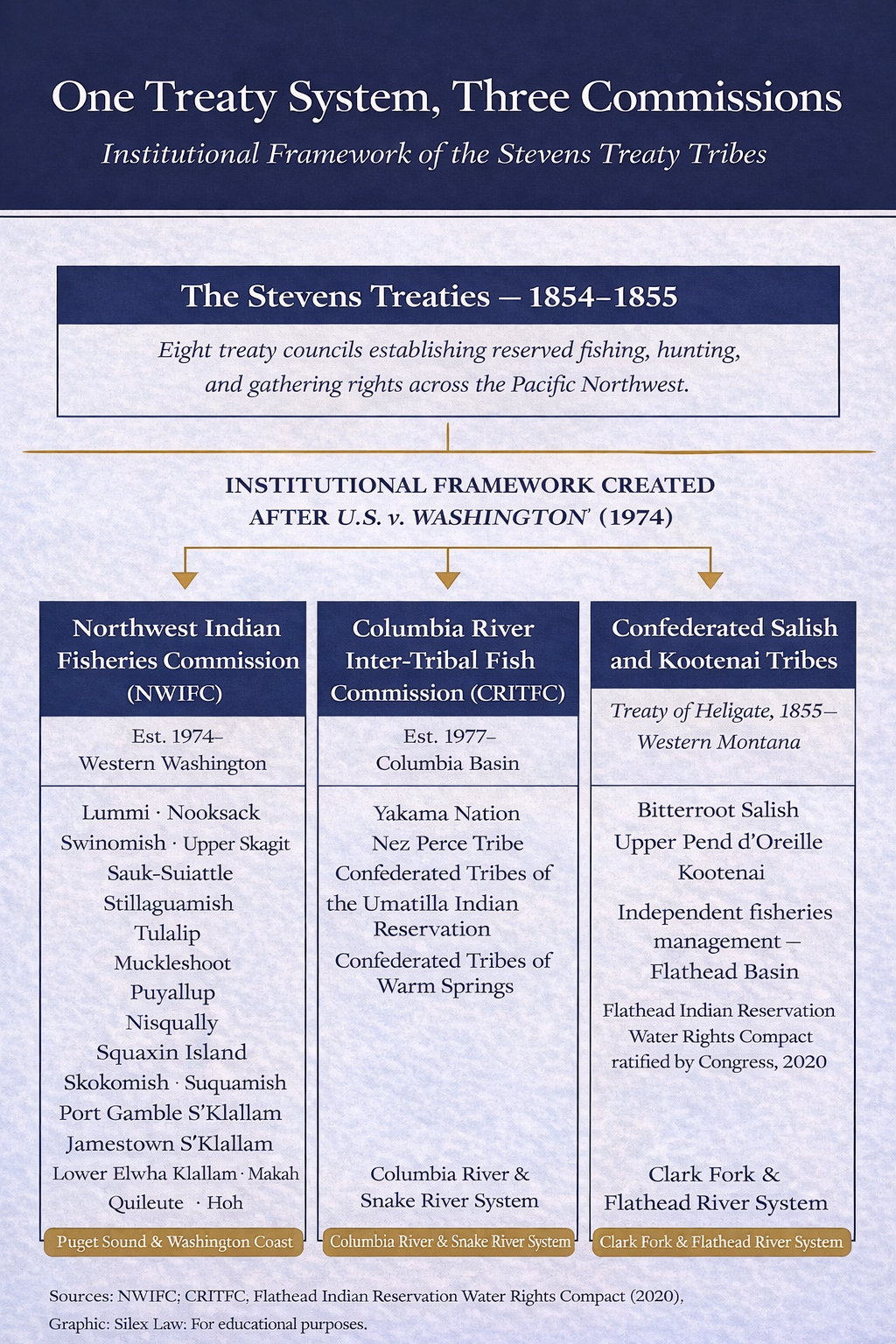
The Boldt Decision established tribal co-management of Washington's salmon fisheries but created an immediate institutional problem: nineteen treaty tribes suddenly held co-management authority and no shared infrastructure to exercise it. The Northwest Indian Fisheries Commission was formed in 1974 to fill that gap. The Columbia River Inter-Tribal Fish Commission followed in 1977 after a parallel ruling in United States v. Oregon extended the same treaty analysis to the Columbia River tribes. The Confederated Salish and Kootenai Tribes, parties to the Treaty of Hellgate, manage their fisheries independently in western Montana. Together the three institutional frameworks cover the full geographic scope of the Stevens Treaty system. Sources: NWIFC; CRITFC; Flathead Indian Reservation Water Rights Compact (2020). Graphic: Silex Law. For educational purposes.
Columbia River Inter-Tribal Fish Commission (CRITFC)
The Columbia River Inter-Tribal Fish Commission was established in 1977, following the federal district court's decision in United States v. Oregon — a parallel proceeding to U.S. v. Washington that applied the same treaty analysis to the Columbia River tribes' fishing rights in Oregon. CRITFC represents four nations whose treaties secured fishing rights across the Columbia River system: the Yakama Nation, the Nez Perce Tribe, the Confederated Tribes of the Umatilla Indian Reservation, and the Confederated Tribes of Warm Springs. Together, these nations hold treaty rights — originating in the Yakama, Nez Perce, and Umatilla Treaties of 1855, and the Dayton Treaty of 1855 with the Warm Springs — to fish at all usual and accustomed places throughout the Columbia Basin, including Celilo Falls and hundreds of miles of tributaries extending into Idaho, Oregon, and Washington.
The Columbia River tribes' treaty fishing rights were affirmed in Winans in 1905, the foundational case establishing that treaty rights are an easement running against subsequent landowners. But the practical exercise of those rights has been constrained for decades by the federal dam system on the Columbia and Snake Rivers. The four lower Snake River dams — Ice Harbor, Lower Monumental, Little Goose, and Lower Granite — block salmon migration to more than 140,000 acres of Idaho spawning habitat that treaty tribes retain the right to fish. Federal courts have repeatedly found that dam operations violate the Endangered Species Act by harming listed salmon runs; the CRITFC tribes have been plaintiffs or intervenors in nearly every such proceeding. The Biden administration's 2024 Columbia Basin Restoration Initiative identified breach of the lower Snake River dams as the most effective path to recovering Snake River salmon, and the treaty right to those fish — senior by federal law to every other water use in the basin — is the legal foundation underlying that policy debate. Resolution of the Snake River dam question is the most consequential open issue in Columbia River treaty rights law.
The Yakama Basin adjudication, pending in Yakima County Superior Court since 1977, will ultimately determine the quantified scope of the Yakama Nation's water rights across Washington's most intensively irrigated watershed. The Nez Perce Tribe's treaty water rights in the Snake River system similarly remain unquantified in most reaches, constituting a large, senior, and formally unresolved prior claim on one of the most litigated river systems in the West.
Confederated Salish and Kootenai Tribes
The Confederated Salish and Kootenai Tribes occupy a distinct position among the Stevens Treaty nations. The CSKT — comprised of the Bitterroot Salish, Upper Pend d'Oreille, and Kootenai peoples — signed the Treaty of Hellgate in July 1855 and were established on the Flathead Reservation in western Montana. Because the CSKT's treaty fishing rights are exercised primarily within Montana, they fall outside the jurisdiction of both the NWIFC and CRITFC; the CSKT manage their own fisheries program independently and through state-tribal agreements with Montana Fish, Wildlife and Parks.
The CSKT's most significant recent legal development is not in fisheries but in water rights. After decades of negotiation, Congress ratified the Flathead Indian Reservation Water Rights Compact in 2020 — the largest Indian water rights settlement in Montana history and among the largest in the United States. The compact quantifies the tribe's reserved water rights across the Flathead Basin, establishes an operational framework for the Flathead Indian Irrigation Project, and provides federal funding for water infrastructure on the reservation. The settlement resolves claims that had been pending since the 1970s and establishes a model for negotiated resolution of treaty water rights that other basins are watching closely.
Ongoing Adjudications and Open Questions
The Stevens Treaty fishing and water rights are not settled law in the sense that their application to specific watercourses, specific forms of development, and specific resource management decisions has been fully resolved. Decades of litigation have established the doctrinal framework — the right exists, it is federal, it is senior, and it carries an implied water right and a right against habitat destruction. What remains open is the scope of those rights as applied to modern conditions that Stevens and tribal leaders never contemplated in 1854 and 1855.
The Yakima Basin adjudication is the largest ongoing water rights proceeding involving Stevens Treaty rights. The case has been pending in Yakima County Superior Court since 1977 and encompasses the treaty rights of the Yakama Nation alongside thousands of state-law water rights in Washington's most agriculturally intensive watershed. Partial decrees have been entered for some parties; comprehensive resolution remains years away. The outcome will define how Stevens Treaty water rights interact with irrigated agriculture in central Washington and will serve as a model for similar proceedings in other basins.
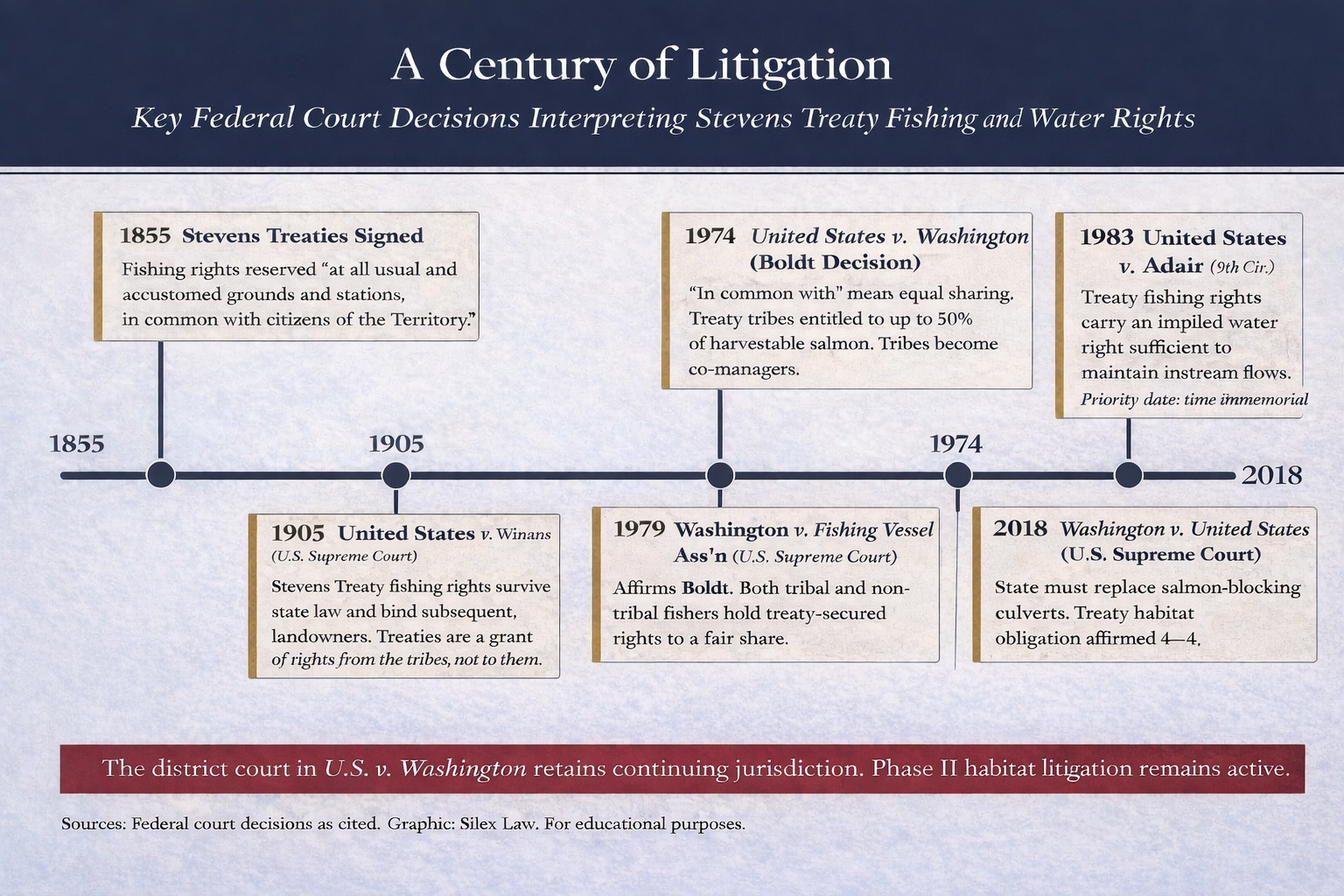
Stevens Treaty fishing and water rights have been contested in federal court for more than a century. The legal progression from Winans (1905) through the Boldt Decision (1974), its Supreme Court affirmance (1979), Adair (1983), and the culverts decision (2018) reflects a consistent judicial direction: the treaties mean what the tribes understood them to mean, and that meaning carries enforceable legal obligations that state law cannot override. The district court in U.S. v. Washington retains continuing jurisdiction; Phase II habitat litigation remains active. Sources: Federal court decisions as cited. Graphic: Silex Law. For educational purposes.
The habitat question extends well beyond culverts. Tribes have begun advancing arguments that state land use decisions — approvals for development, road construction, shoreline modification, and agricultural practices that degrade salmon habitat — can constitute treaty violations in the same way that barrier culverts did. Those arguments have not been definitively resolved in court, but the Phase II logic does not exclude them. As climate change accelerates summer stream temperature increases and reduces low-water flows across the Pacific Northwest, the gap between what the treaty promised and what the resource can deliver will grow, and the legal pressure on habitat protection obligations will intensify.
The Columbia River treaty tribes — the Yakama, Nez Perce, Umatilla, and Warm Springs — have focused particular attention on the four lower Snake River dams operated by the Army Corps of Engineers. Those dams block salmon migration to hundreds of miles of Idaho spawning habitat that treaty tribes retain the right to fish. Federal courts have repeatedly found that dam operations violate federal environmental law in ways that harm treaty fisheries; the Biden administration's final environmental impact statement on Columbia Basin salmon recovery, released in 2024, identified dam removal or major modification as the most effective path to recovering Snake River salmon. The treaty right to those fish — senior by federal law to every other claim on the Columbia system — is the legal foundation underlying every dimension of that debate.
Additional Resources
Foundational Cases
United States v. Winans, 98 U.S. 371 (1905) — U.S. Supreme Court hold that Stevens Treaty fishing rights are an easement running against subsequent landowners; establishes the principle that the treaties are a grant of rights from the Indians, not to them.
United States v. Washington, 384 F. Supp. 312 (W.D. Wash. 1974) — Boldt Decision — Judge Boldt holds that “in common with” means equal sharing — treaty tribes are entitled to up to 50 percent of the harvestable salmon in their usual and accustomed areas; tribes become co-managers of the state fishery.
Washington v. Washington State Commercial Passenger Fishing Vessel Ass’n, 443 U.S. 658 (1979) — U.S. Supreme Court affirms the Boldt decision; both tribal and non-tribal fishers hold treaty-secured rights to a fair share of available fish.
United States v. Washington (Phase II), 506 F. Supp. 187 (W.D. Wash. 1980) — Judge Orrick holds that the treaty right includes a right against man-made habitat destruction; hatchery fish counted in tribal harvest share.
United States v. Adair, 723 F.2d 1394 (9th Cir. 1983) — Ninth Circuit holds that treaty fishing rights carry an implied water right sufficient to maintain instream flows for the fisher, with a priority date of time immemorial.
Washington v. United States (Culverts Decision), 584 U.S. ___ (2018) — U.S. Supreme Court affirms (by equally divided 4-4 court) the injunction requiring Washington state to replace salmon-blocking culverts under state roads by 2030.
State & Federal Agency Resources
Washington Department of Fish & Wildlife — Treaty History with the Northwest Tribes — WDFW overview of the Stevens Treaties, treaty fishing and hunting rights, and co-management framework.
Northwest Indian Fisheries Commission (NWIFC) — Inter-tribal commission representing twenty treaty tribes in western Washington; coordinates co-management of salmon and other resources with WDFW.
Columbia River Inter-Tribal Fish Commission (CRITFC) — Represents the Yakama Nation, Nez Pierce Tribe, Confederated Tribes of the Umatilla Indian Reservation, and Confederated Tribes of Warm Springs in Columbia River fisheries management.
Washington Governor’s Office of Indian Affairs — State-level overview of treaty rights and tribal-state co-management relationships in Washington.
Academic & Research Resources
University of Washington Law Library — United States v. Washington (Boldt Decision) Research Guide — Comprehensive legal research guide to U.S. v. Washington and its progeny, including links to digitized briefs, scholarly commentary, and case chronology.
Wilkinson, Charles F. — Treaty Justice: The Northwest Tribes, the Boldt Decision, and the Recognition of Fishing Rights. (University of Washington Press, 2024) — The definitive account of the Fish Wars, the Boldt decision, and fifty-year legal aftermath — written by the foremost scholar of federal Indian law and completed just before Wilkinson’s death in 2023.
HistoryLink.org — “Boldt Decision: United States v. State of Washington” (Essay 21084). — Comprehensive public history essay covering the Fish Wars, the treaty fishing rights movement, Judge Boldt’s 1974 ruling, the Supreme Court affirmance, and the co-management framework that followed — written for a general audience by Washington State’s online encyclopedia of history.