
Water law in the American West operates on a fundamentally different set of principles than water law in the rest of the United States. Understanding those principles — and their limits — is the starting point for understanding any legal question involving Western water rights, from a municipal supply contract to a tribal water settlement to the management of a river system under drought conditions.
Prior Appropriation & Western Water Rights
What is Prior Appropriation?
Prior appropriation is the legal doctrine governing water rights across most of the American West. At its core, the doctrine rests on a single organizing principle: the first person to put water to a beneficial use acquires a right to continue that use, and that right is superior to any later claimant. This is the “first in time, first in right” rule — a priority system that determines who gets water when there isn’t enough for everyone.
A water right under prior appropriation is not a property right in the water itself. It is a usufructuary right — the right to use a specific quantity of water, for a specific beneficial purpose, at a specific point of diversion, in accordance with an established priority. The water remains a public resource. What the right-holder owns is the entitlement to use it under defined conditions.
Four elements define a valid prior appropriation water right:
Intent to appropriate. The right-holder must have formed an intent to divert and use the water for a beneficial purpose.
Diversion. Water must actually be removed from the natural stream or source. Under traditional prior appropriation, a right cannot be established by leaving water in the stream — it must be put to use.
Beneficial use. The water must be applied to a recognized beneficial use. Historically, beneficial uses were defined narrowly — irrigation, mining, municipal supply, stock watering. Modern beneficial use definitions have expanded in most Western states to include instream flows, recreational uses, and environmental purposes, though the scope varies significantly by state.
Priority date. The right carries a priority date — typically the date of first diversion or the date of filing, depending on state law — that determines its position in the priority system relative to all other rights on the same source.
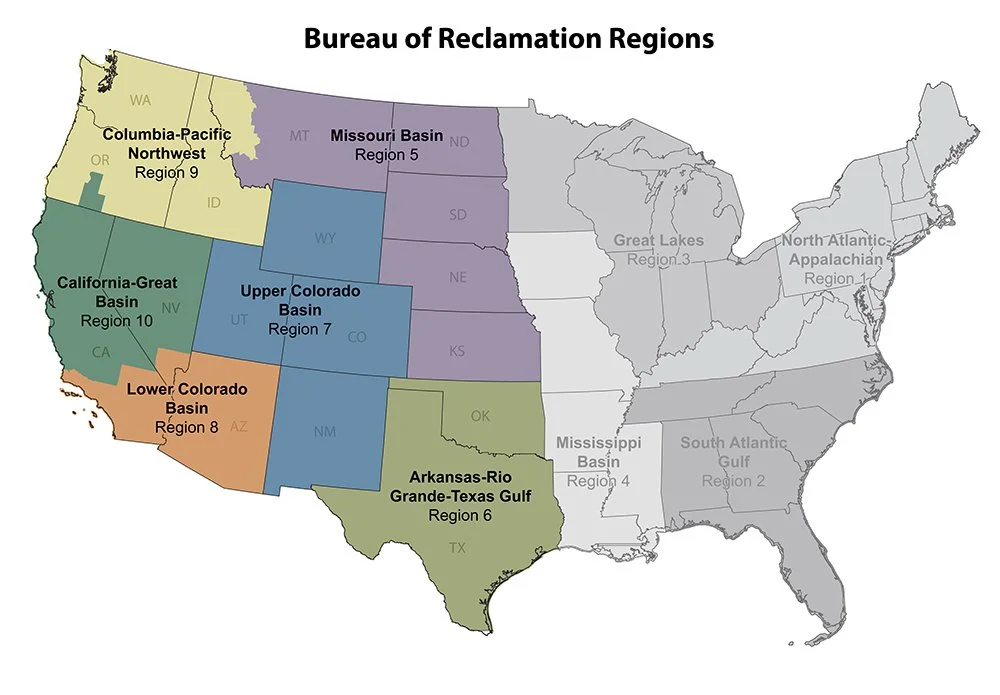
The Bureau of Reclamation manages water and power infrastructure across the American West through seven regional offices. The colored regions indicate active Reclamation water management areas, encompassing the Colorado River Basin, the Columbia River Basin, and all other major western river systems subject to federal reclamation law. Source: U.S. Bureau of Reclamation (public domain).
How Prior Appropriation Developed
Prior appropriation did not emerge from legislation or deliberate legal design. It developed organically from the practical realities facing miners and farmers in the arid American West during the mid-nineteenth century.
The Eastern United States had imported the English common law riparian doctrine, under which the right to use water belongs to the owner of land adjacent to a watercourse. Riparian rights are correlative — all riparian landowners share the resource and must use it reasonably in relation to one another. That system functions reasonably well in humid climates where water is relatively abundant and land ownership and water access naturally coincide.
In the arid West, it was unworkable. Mining operations needed water transported far from streams to where the ore was. Irrigated agriculture required diverting water across long distances to reach arable land that was rarely adjacent to a reliable water source. The riparian system, which tied water use to land ownership along the stream, could not accommodate either.
Western communities developed prior appropriation in response — a system that severed the connection between land ownership and water rights, allowed water to be transported to wherever it could be put to beneficial use, and resolved competing claims through a clear priority hierarchy rather than a correlative sharing arrangement. California gave the doctrine its first significant legal recognition in the 1850s. Colorado elevated it to a constitutional principle in 1876. By the turn of the twentieth century, prior appropriation was the dominant water law doctrine across the region.
The doctrine spread unevenly, and several Western states — including California, Oregon, and Washington — developed hybrid systems that retained elements of riparian law alongside prior appropriation. The result is a Western water law landscape that shares a common foundational logic but varies in its administrative details, procedural requirements, and the relative weight given to riparian and appropriative claims from state to state.
The Priority System in Practice
The priority system is prior appropriation’s most consequential operational feature. When a water source cannot supply all existing rights — which in the American West is not an exceptional condition but a recurring one — rights are satisfied in order of their priority date. Senior rights are filled first. Junior rights are curtailed until senior rights are fully satisfied or the source runs dry.
Water administrators manage this through a mechanism known as a “call.” When a senior right-holder is not receiving their full entitlement, they can place a call on the river. The call requires the water administrator — typically a state engineer or water commissioner — to curtail all upstream junior diversions until the senior right is satisfied. The call travels upstream through the priority system, shutting off junior users in reverse order of their priority dates until the calling right is met or there is no more water to allocate.
The practical consequences of the priority system are significant. A water right with a priority date of 1890 is legally senior to one established in 1920, regardless of the relative size of the two rights or the economic importance of their respective uses. In times of shortage, the 1920 right may receive nothing while the 1890 right is fully satisfied. This is not a failure of the system — it is the system operating as designed.
Priority dates in the Colorado River Basin reflect the settlement history of the region. The oldest and most senior rights on the river belong to agricultural users and tribal nations whose water use predates the major infrastructure development of the twentieth century. The junior position of more recently established rights — including, critically, Arizona’s Central Arizona Project entitlement — defines the exposure of those users under shortage conditions and shapes every negotiation over the river’s future management.
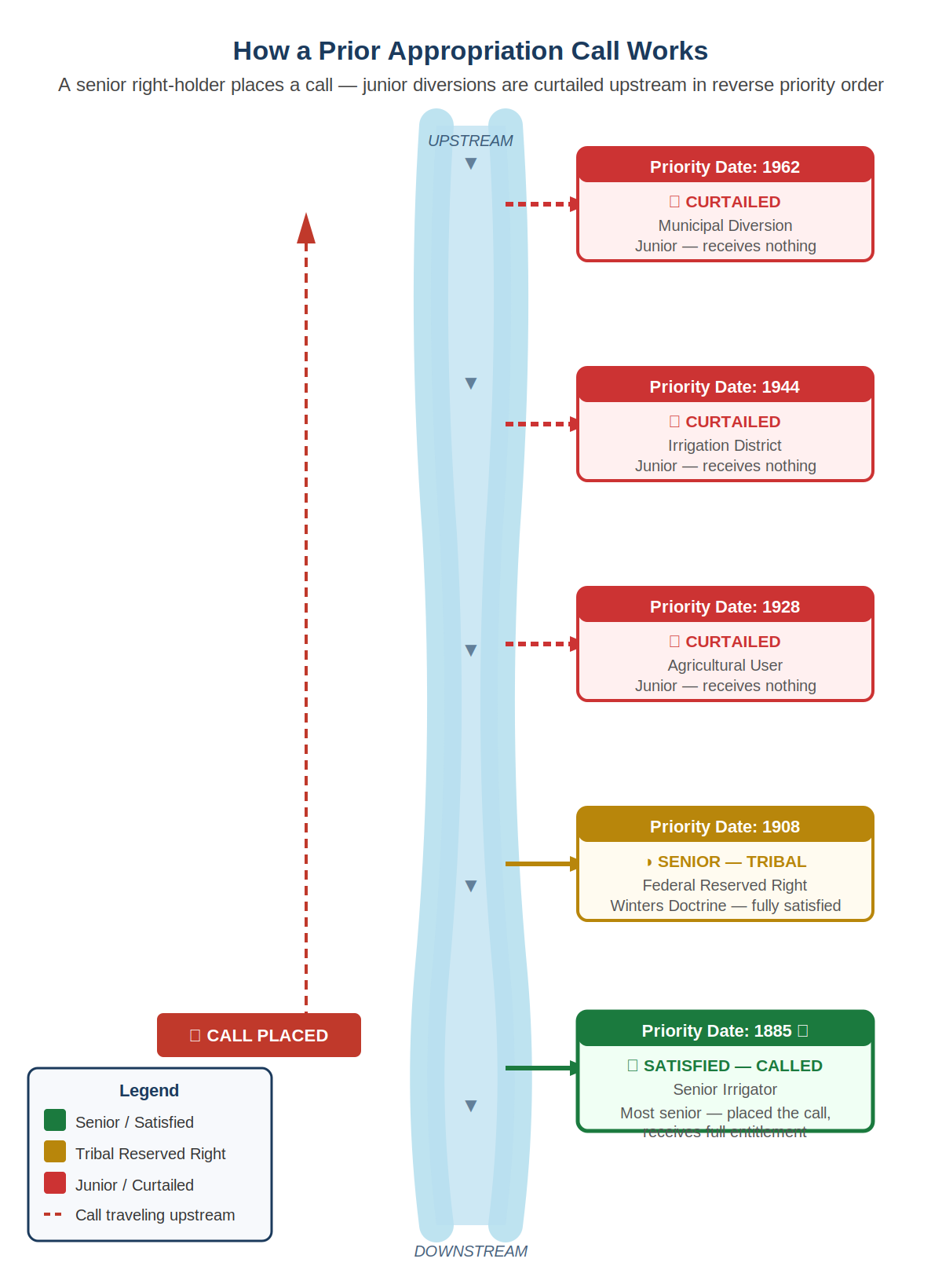
How a Prior Appropriation Call Works. When a senior right-holder places a call, the water administrator curtails junior diversions upstream in reverse priority order until the senior right is satisfied. Under the Winters Doctrine, tribal reserved rights carry priority dates from the reservation establishment, preceding most other rights on a river system.
Limits and Exceptions
Prior appropriation governs water rights within states, but it does not govern water allocation between them. Interstate water law on shared river systems operates through a separate legal framework — interstate compacts, congressional apportionment, and Supreme Court adjudication — that overlays and in some respects supersedes the state-level priority system.
On the Colorado River, the 1922 Colorado River Compact divided the river between the Upper and Lower Basins and allocated 7.5 million acre-feet annually to each. That allocation was made without reference to the prior appropriation priority dates of individual state users. The Compact created a separate tier of legal obligation — the Upper Basin’s delivery requirement at Lee Ferry — that operates independently of any individual state’s internal priority administration. A Compact Call, in which the Lower Basin demands delivery of its full entitlement, would require the Upper Basin states to curtail uses collectively, regardless of individual priority dates within those states.
Federal law creates additional limits on the prior appropriation system. The federal government holds reserved water rights on federal lands — national parks, national forests, military installations, and Indian reservations — that arise not from state law appropriation but from the federal act reserving the land for a specific purpose. These rights are not subject to the beneficial use and diversion requirements of state prior appropriation law, and they carry a priority date of the reservation’s establishment, which in many cases predates the water rights of surrounding state users by decades.
The intersection of federal reserved rights with state prior appropriation systems is one of the most complex and consequential areas of Western water law — and one of the most actively litigated.
Prior Appropriation & Tribal Water Rights
Tribal water rights occupy a unique and senior position within the Western water law framework — one that the prior appropriation doctrine did not create and cannot fully accommodate.
When the federal government established Indian reservations, it impliedly reserved the water necessary to fulfill the reservation’s purpose. This principle — established by the Supreme Court in Winters v. United States in 1908 and known as the Winters Doctrine — means that tribal reserved water rights arise as a matter of federal law, not state appropriation law. They do not require diversion or beneficial use in the prior appropriation sense. They do not lose validity through non-use. And their priority date is the date the reservation was established — which for most Colorado River Basin tribes predates the entire prior appropriation infrastructure built around the river in the twentieth century.
The practical consequence is significant: tribal reserved water rights are senior to virtually every non-tribal water right on the Colorado River system. The rights quantified for five Lower Basin tribes in Arizona v. California (1963) — the Chemehuevi, Cocopah, Colorado River Indian Tribes, Fort Mojave, and Fort Yuma (Quechan) — were recognized as present perfected rights with priority dates preceding the Boulder Canyon Project Act. Those rights sit at the top of the Lower Basin priority hierarchy.
But quantification remains incomplete across much of the basin. Many tribal nations hold unquantified reserved water rights — rights whose existence is established in federal law but whose precise scope has never been determined through litigation or settlement. Unquantified rights create uncertainty for every other water user in the system, because a senior right of unknown magnitude cannot be fully accounted for in any operational model or shortage scenario.
The prior appropriation system’s emphasis on use, diversion, and administrative certainty sits in fundamental tension with the character of tribal reserved rights. That tension has not been resolved. It is one of the defining unresolved legal questions in Western water law, and it will become more acute as shortage conditions on the Colorado River force a reckoning with the gap between allocated rights and available supply.
Additional Resources
Foundational Cases
Coffin v. Left Hand Ditch Co. (1882) - Colorado Supreme Court’s foundational prior appropriation ruling.
Winters v. United States (1908) - U.S. Supreme Court establishes federal reserved water rights for Indian reservations.
Arizona v. California (1963) - U.S. Supreme Court apportions the Colorado River among the Lower Basin states, confirms federal authority over water allocation under the Boulder Canyon Project Act, and quantifies federal reserved water rights for five Lower Basin tribal nations.
Agency Resources
National Conference of State Legislatures - “State Water Governance Approaches from Six Western States”.