
ABOUT THE PRACTICE
Silex Law

Water is the most contested and consequential resource in the American West. The legal framework that governs it is a century old, structurally overallocated, and under pressure from every angle. Zach Stevens practices at the center of that framework — not as an observer, but as someone who has sat at the table when the decisions shaping Western water systems were actually being made.
He grew up in Salt Lake City and spent the years after law school in Arizona, where western water law is not an abstraction but a daily operational reality — felt in the state legislature, the tribal councils, the agricultural economy, and the negotiating rooms where the Colorado River’s future gets decided.
The stakeholders are many, the interests are genuinely opposed, and the decisions that result from those negotiations carry consequences that last generations.
He came to this work through formal legal training and through years of direct immersion in the institutions and negotiations that shape it. That combination — the academic foundation and the firsthand experience — is what the practice is built on.
His first years after law school placed him at the table for Arizona’s Drought Contingency Plan — one of the most significant water management agreements in the Colorado River Basin in a generation.
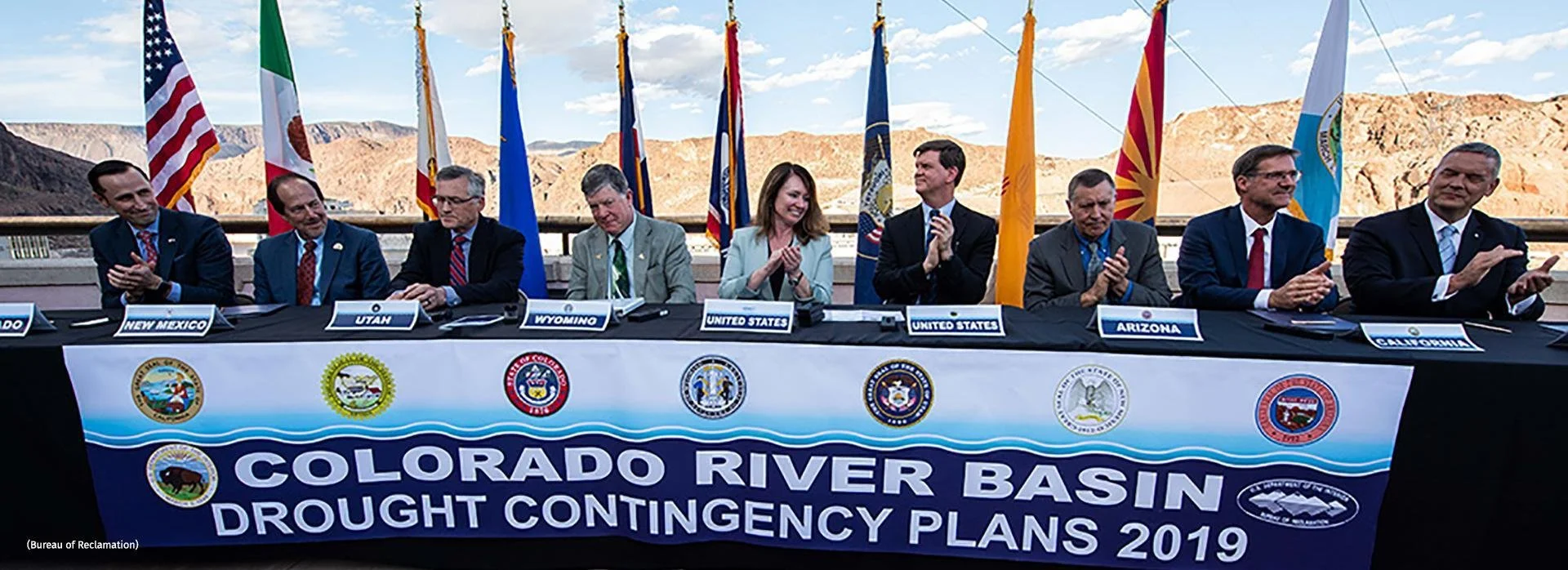
DCP Signing Ceremony, May 20, 2019, Hoover Dam
Working alongside licensed counsel in a direct advisory and representational capacity, he participated in negotiations on behalf of a major Colorado River tribal nation — work that produced $38 million in compensation for 150,000 acre-feet of system conservation stored in Lake Mead at a moment when the reservoir’s elevation was a matter of genuine regional urgency.
Simultaneously, working on behalf of a separate tribal client in the renegotiation of Arizona’s Tribal-State Gaming Compact, he helped develop a mechanism that secured $5 million for each non-gaming tribe through coalition negotiation that required as much political fluency as legal skill.
From there he moved deeper into tribal governance, serving in a direct advisory capacity within a tribal General Counsel’s office. Operating from inside an institution — present in council meetings, embedded in day-to-day governance, advising on matters affecting the tribe’s members, resources, and long-term interests — provided a perspective on tribal governance that most outside counsel never develop.
He worked alongside federal agencies on water rights settlement matters, supported the tribe’s ranching and commercial operations, and led due diligence on a $10 million acquisition.
A subsequent engagement with a Fortune 500 defense contractor expanded his transactional range into federal procurement, negotiating Department of Defense and federal agency contracts under the Federal Acquisition Regulation and its agency-specific implementations.
His most recent engagement was with a major Colorado River Basin tribal nation. Over the course of that representation, he drafted a comprehensive Tribal Water Code — one of the first in the basin to formally address off-reservation water leasing and to incorporate a Rights of Nature framework recognizing the Colorado River’s legal personhood.
He also drafted a revised Tribal Gaming Code, a Police Standard Operating Procedure Manual, and a government-wide Small UAS policy, while serving as the tribe’s representative to regional water governance bodies and contributing to high-level basin discussions shaping how tribal water rights will be exercised for years to come. That body of work now informs the practice of Silex Law.
Based in Salt Lake City — where he returned after years of work in Arizona — the firm serves state and tribal governments, water districts, agricultural operations, and clients across the American West whose most consequential decisions involve water law, property interests, and western resource policy.
Admitted to practice in Washington State, the firm is positioned to serve tribal governments and water rights clients across the Pacific Northwest, where treaty-reserved water rights, salmon recovery obligations, and the evolving demands on the Columbia River Basin present their own generation of consequential legal questions. Utah Bar admission is also forthcoming, where the upper basin states are navigating their own reckoning with a river that can no longer meet every obligation downstream.
Credentials
Juris Doctor
Sandra Day O’Connor College of Law
Arizona State University, 2018
Education
University of Utah, 2013
B.S., Political Science
B.A., International Studies
Certificate in International Relations
Outside the office, he is an avid rock climber and camper with deep roots in Salt Lake City, where he lives with his Goldendoodle.
“The most important decisions in western water law are not made in courtrooms. They are made at negotiating tables, in policy meetings, in the quiet back-and-forth between people who understand what each party needs and have the skill to build something both sides can accept.”