
The Salton Sea Crisis
California's largest lake was never meant to exist.
The Salton Sea sits in the Salton Sink, a low-lying basin in the Southern California desert that has filled and evaporated multiple times over thousands of years. The modern lake is not a product of nature or policy — it is the result of an engineering failure. In 1905, a diversion canal being constructed to bring Colorado River water to the Imperial Valley gave way under floodwater pressure. For nearly two years, the Colorado River flowed uncontrolled into the basin before workers could seal the breach. By the time they did, a lake roughly the size of Rhode Island had formed in the desert.
The Cahuilla people who lived in the region were familiar with the recurring lake — their oral traditions described it — and many fled to higher ground as the water rose. That history matters, and we return to it below.
Once the breach was sealed, the Salton Sea had no natural river feeding it. What kept it alive — and what still sustains it today — is irrigation return flows: water used to grow crops in the Imperial and Coachella Valleys that drains back into the basin rather than evaporating or percolating into the ground. The Sea is, in other words, a byproduct of agriculture. That dependency is the source of every legal problem that follows.
Why This Matters to You
The Salton Sea is sometimes framed as a wildlife issue for people who care about pelicans. The public health record and the economic exposure tell a different story — and neither one waits for anyone’s environmental sympathies before taking effect.
The health consequences in surrounding communities are documented and severe. As the Sea has receded, it has exposed nearly 20,000 acres of lakebed playa containing decades of agricultural runoff: arsenic, selenium, cadmium, copper, zinc, DDT residue, and organochlorine pesticides. Desert winds carry these particles into surrounding communities. A USC study of 722 school-age children near the Salton Sea found that 24% had asthma — nearly three times the national average. A UC Irvine study published in the American Journal of Respiratory and Critical Care Medicine established a direct, measurable association between dust exposure hours and declining lung function in children. On October 6, 2022, a single dust storm drove the EPA Air Quality Index to 659 at a monitoring station on the Sea’s western shore — more than four times the threshold for hazardous air quality. Imperial County already has twice the rate of pediatric asthma-related emergency room visits relative to California as a whole.
The regional economic exposure is enormous — and extends well beyond the Imperial Valley.Coachella Valley and Imperial Valley together produce a substantial share of the nation’s winter vegetables, dates, and citrus. The region’s agricultural economy depends on a workforce that lives within the dust plume. If respiratory disease rates continue rising, if habitability declines, or if federal intervention disrupts the water supply arrangements that support Imperial Valley agriculture — the supply chain consequences reach every grocery store in the country. The consumer in San Francisco who does not care about the Salton Sea is directly downstream of those consequences.
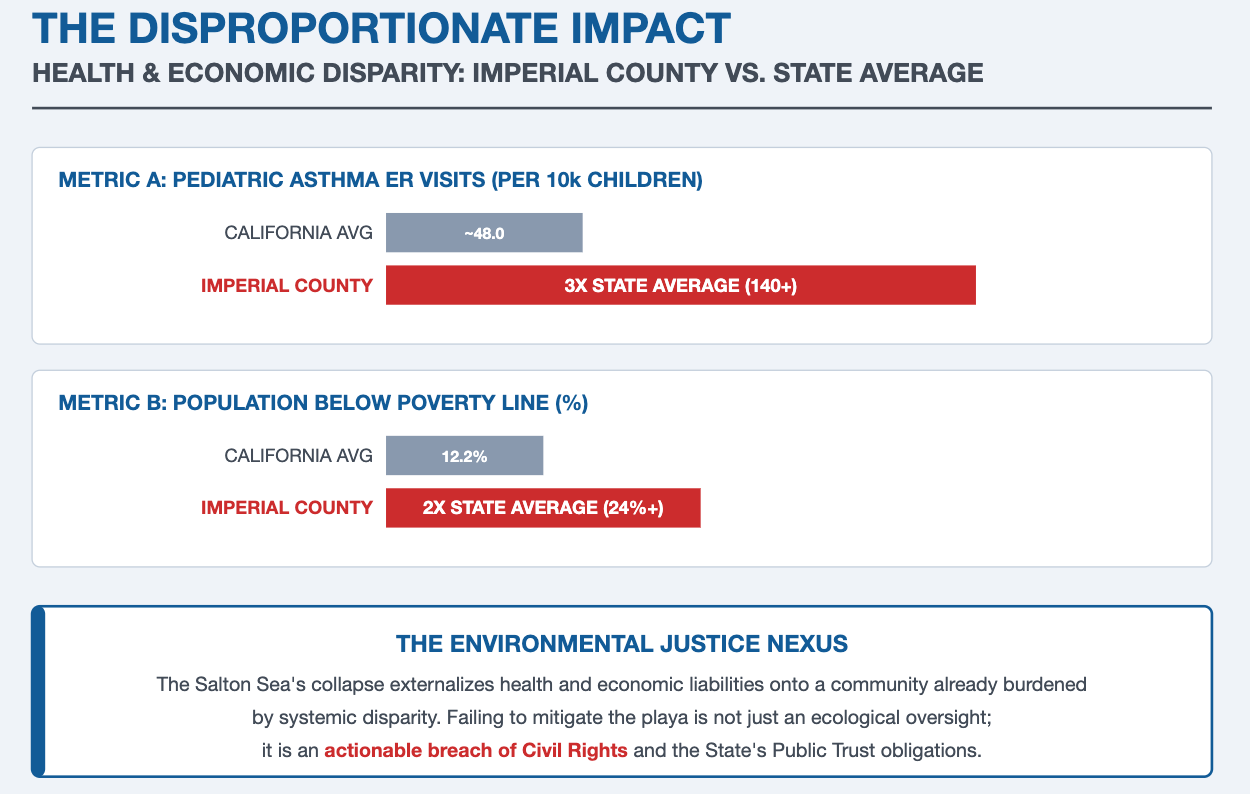
Imperial County's pediatric asthma ER visit rate runs three times the California average; its poverty rate is double the state baseline. The data reflect decades of environmental costs externalized onto a community with limited political recourse. Source: California OEHHA CalEnviroScreen 4.0; U.S. Census Bureau Imperial County Profile. Graphic: Silex Law.
The statutory and fiscal exposure is already accumulating. California’s Salton Sea Restoration Act imposed mandatory acreage targets for lakebed habitat restoration. The State Water Resources Control Board issued a stipulated order in 2017 establishing specific restoration obligations. Those targets are substantially unmet. When a state fails to meet its own restoration mandates, federal intervention under the Clean Water Act and related statutes becomes more likely — and federal remediation programs are funded by taxpayers, not by the water users whose decisions drove the decline. The Owens Lake precedent is instructive: Los Angeles ratepayers have spent more than $2.5 billion mitigating dust from a single drained lake. The Salton Sea’s exposed playa is projected to exceed 60,000 acres by 2028. The mitigation liability scales directly with that acreage.
Imperial County’s population is approximately 80% Hispanic and 10.5% Black — communities that have largely not been included in the political decisions that reduced water flows to the Sea. The water law decisions are made elsewhere. The costs are borne locally. But the economic and fiscal ripple effects of continued inaction extend well beyond the communities absorbing the health burden today.
How the Sea is Sustained — and Why That’s the Problem
The Imperial Valley is one of the most productive agricultural regions in the United States, and one of the thirstiest. It receives virtually no rainfall. Everything grows on water delivered from the Colorado River by the All-American Canal, the largest irrigation canal in the world. Farmers apply that water to their fields; a portion returns as drain water and flows through the New River, the Alamo River, and the Whitewater River into the Salton Sea.
For decades, those return flows sustained the lake at roughly stable levels. The Sea became — despite being saltier than the ocean and situated in one of the hottest, driest places in North America — an ecologically significant body of water. It sits along the Pacific Flyway, the migratory corridor stretching from Alaska to Patagonia, and provides critical habitat for more than 400 species of birds, many of them dependent on the Sea because more than 95 percent of California's historical wetlands have been converted to other uses. Several federally listed fish and bird species call the Sea home.
Here is the structural problem: because the Sea is fed by agricultural runoff rather than a river, any reduction in agricultural water use reduces inflows to the Sea. The two goals — using Colorado River water more efficiently and maintaining the Salton Sea ecosystem — are in direct tension. Every acre-foot of water conserved in the Imperial Valley is, in the most direct physical sense, an acre-foot not flowing into the Sea.
That tension did not become a legal crisis until 2003.
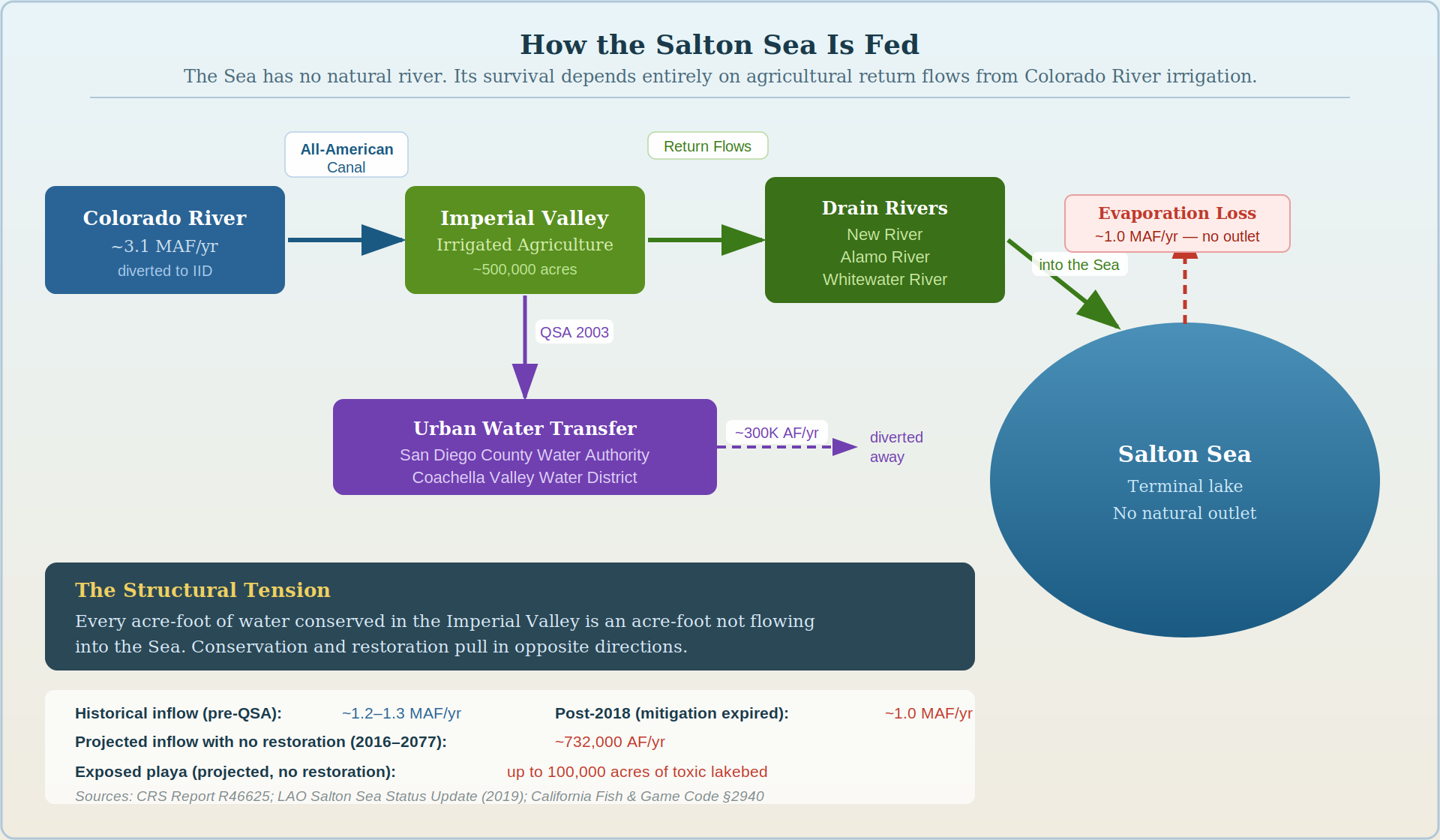
The Salton Sea has no natural river inlet. Its survival depends entirely on agricultural return flows from Colorado River irrigation delivered through the All-American Canal — water that drains from Imperial Valley fields through the New River, Alamo River, and Whitewater River into the basin. Source: CRS Report R46625; LAO Salton Sea Status Update (2019); California Fish & Game Code §2940. Graphic: Silex Law.
The Quantification Settlement Agreement (QSA) and the Broken Bargain
For most of its history, California used more Colorado River water than its legal entitlement under the 1922 Colorado River Compact. California's compact allocation is 4.4 million acre-feet per year — the largest of the seven basin states — but through the 1990s, California regularly drew 800,000 acre-feet or more in excess of that figure. It could do so because Upper Basin states were not yet using their full allocations. As those states grew and began claiming their shares, the Interior Department required California to get its use in line with its compact entitlement.
The result was the Quantification Settlement Agreement of 2003, a landmark agreement among the Imperial Irrigation District, the Coachella Valley Water District, the San Diego County Water Authority, the State of California, and the federal government. The QSA accomplished two things simultaneously: it brought California into compliance with its compact allocation by redirecting roughly 300,000 acre-feet per year of Imperial Valley water to urban users in San Diego and Coachella Valley, and it created a legal framework for dealing with the consequences of that transfer for the Salton Sea.
Those consequences were foreseeable. Redirecting agricultural water to cities meant less irrigation return flow into the Sea. To cushion the transition, the QSA required the Imperial Irrigation District to continue sending mitigation water — 200,000 acre-feet per year — to the Sea for a fixed period. That obligation expired in 2017. After 2017, the Sea received the full force of the inflow reduction with no buffer.
The QSA also assigned legal responsibility for what came next. Under the agreement and the California legislation that enacted it, the State of California assumed sole responsibility for restoring and managing the Salton Sea ecosystem going forward. The state's obligation is not discretionary. It is written into statute.
That obligation has not been met.
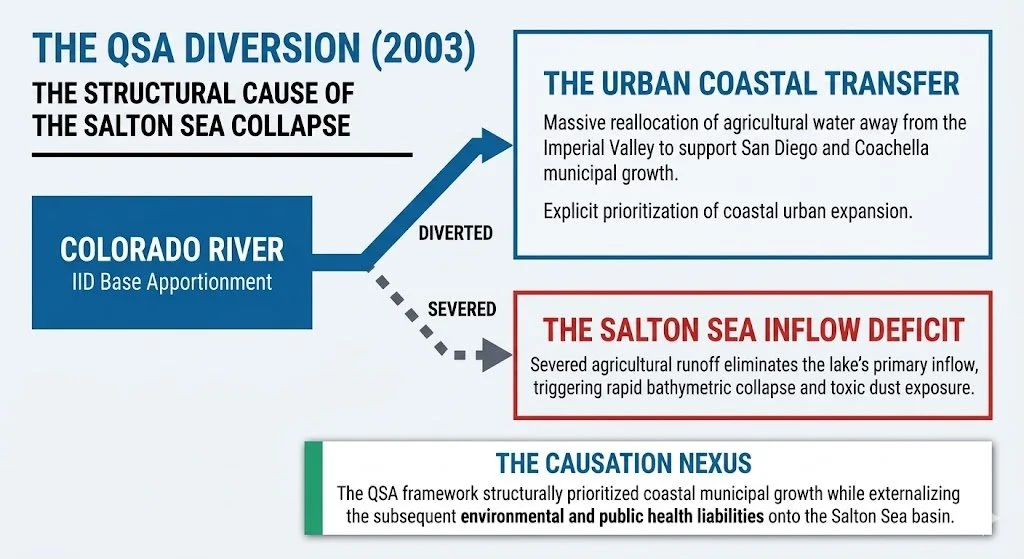
The 2003 Quantification Settlement Agreement permanently redirected hundreds of thousands of acre-feet from Imperial Valley agriculture to coastal urban users, severing the return flows that had sustained the Salton Sea for a century. The mitigation buffer expired in 2017. The Sea has absorbed the full force of that inflow reduction ever since. Source: 2003 Quantification Settlement Agreement; Imperial Irrigation District historical flow data. Graphic: Silex Law.
California’s Legal Obligations and the Enforcement Gap
The Salton Sea Restoration Act, enacted alongside the QSA, commits California to restoring the Salton Sea ecosystem and permanently protecting the wildlife dependent on it. The California Natural Resources Agency leads that effort through the Salton Sea Management Program, a ten-year plan adopted in 2018 after years of failed attempts to agree on a comprehensive approach.
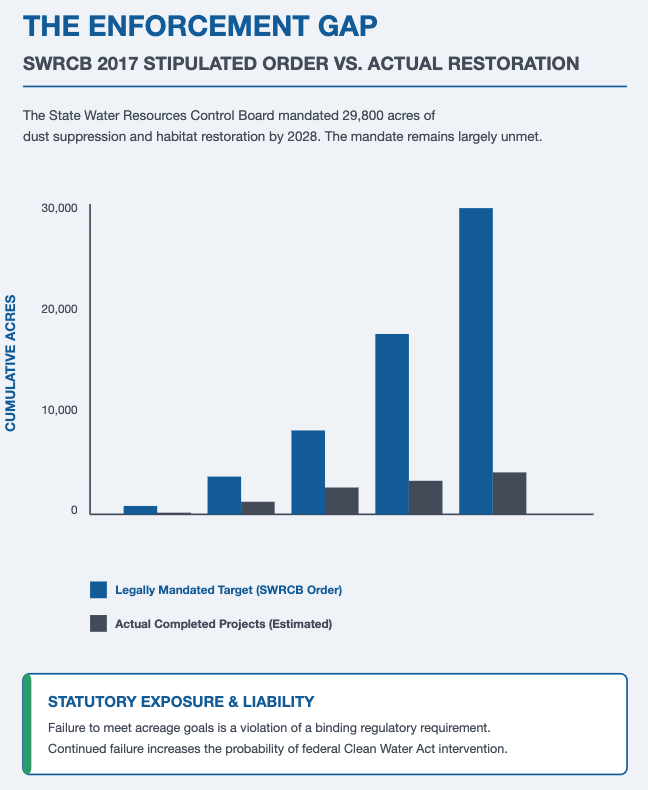
California's actual dust suppression and habitat acreage falls well short of the annual targets mandated by the State Water Resources Control Board's 2017 Stipulated Order — a gap that constitutes an active regulatory violation, not a policy shortfall. Source: SWRCB Order 2017-0134; California Natural Resources Agency Annual Progress Report. Graphic: Silex Law.
The Management Program set concrete targets: 29,800 acres of constructed habitat and dust suppression projects on exposed lakebed by the end of 2028, with annual acreage milestones ramping up over time. In 2017, the State Water Resources Control Board issued a stipulated order requiring the state to meet those targets. The SWRCB order gave the restoration mandate regulatory teeth — failure to meet acreage goals is not just a policy shortfall, it is a violation of a binding regulatory requirement.
The state is behind.
As of the most recent legislative analyses, the Salton Sea Management Program has fallen short of its annual acreage targets, and the funding picture remains uncertain. California voters approved restoration bonds through Propositions 1 (2014) and 68 (2018), and the QSA water agencies have contributed to a joint mitigation fund. But actual project construction has lagged significantly behind what the ten-year plan projected. The preferred restoration alternative studied in 2007 was estimated to cost $9 billion — a figure the Legislature has never funded and shows no signs of funding in full.
Meanwhile, the Sea continues to recede. As water levels drop, lakebed sediment that accumulated decades of agricultural runoff — pesticides, selenium, fertilizer residue — is exposed to desert winds. The Imperial Valley already has some of the worst childhood asthma rates in California. The connection between exposed playa and respiratory illness is documented and worsening.
The legal question that has not been fully tested is what happens when the state continues to miss its own court-ordered acreage targets. The SWRCB's 2017 order created an enforcement mechanism, but California has not faced serious legal consequences for the gap between obligation and performance. Whether environmental groups or affected communities pursue that avenue remains an open question.
The Tribal Dimensions
The Torres Martinez Desert Cahuilla Indians hold a federal reservation of approximately 24,000 acres in Imperial and Riverside Counties. Nearly half of that reservation is underwater — not metaphorically, but literally. When the 1905 canal breach flooded the Salton Sink, the rising water inundated roughly 9,000 acres of reservation land that the federal government had set aside for the Tribe just years before.
The federal government did not compensate the Tribe for the loss at the time. Instead, in 1909, it added additional land to the reservation — much of it also submerged. The Tribe spent decades in litigation over the flooding of its trust lands, ultimately settling with the Imperial Irrigation District and Coachella Valley Water District in 1996 under the Torres-Martinez Desert Cahuilla Indians Claims Settlement Act. As part of that settlement, the Tribe and the United States conveyed permanent flowage easements over approximately 11,800 acres of Indian trust lands to the water districts — a legal recognition that the flooding was permanent and that the Tribe's land would remain submerged indefinitely.
The settlement resolved the historical land claim. It did not resolve the Tribe's relationship to the Sea's future. As the Sea recedes, previously submerged tribal land re-emerges — raising new questions about land status, restoration obligations, and what the Tribe's rights are with respect to the land that surfaces as the water pulls back. The 2022 agreement between the Tribe, the Salton Sea Authority, and water supplier Cadiz Inc. to provide 5,000 acre-feet of water per year to the Sea and tribal lands reflects the Tribe's active role in restoration efforts, but the underlying legal questions about emerging tribal land have not been definitively resolved.
The lithium extraction projects discussed in the next section add another dimension. The southeastern shores of the Salton Sea, where lithium brine deposits are concentrated, overlap with areas of tribal cultural significance. Environmental review processes for proposed extraction facilities have drawn objections from tribal representatives who argue that consultation requirements under California's AB 52 were not adequately followed.
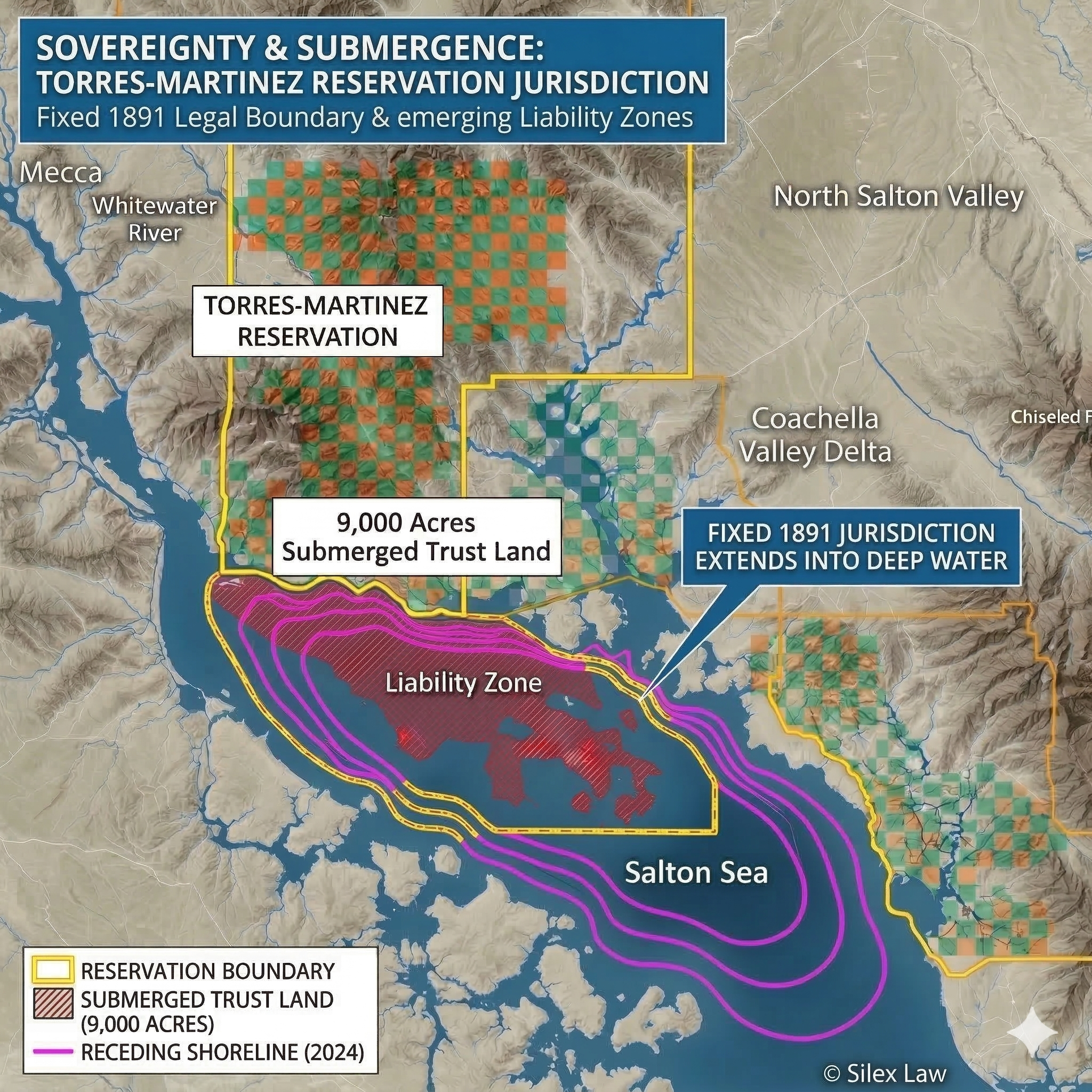
The Torres-Martinez Desert Cahuilla Reservation's fixed 1891 boundaries extend into the Salton Sea. As the shoreline recedes, approximately 9,000 acres of submerged trust land re-emerge as toxic playa — an environmental liability zone the 1996 settlement did not resolve. Source: Bureau of Indian Affairs; U.S. Geological Survey. Graphic: Silex Law.
What Comes Next — and the Lithium Complication
The Salton Sea's situation in 2026 is different from most western water crises in one important respect: the legal obligations are not ambiguous. California is required by statute and by a binding SWRCB order to restore the Sea. The question is not whether the obligation exists — it is whether the state will meet it, and whether the political will to fund and enforce that obligation will materialize before the ecological window closes.
Silex Law's assessment identifies three potential pathways to meaningful progress. None is being actively pursued in an advanced legal posture. Each carries significant obstacles and all of them share a common denominator: they cost money, either through new infrastructure or through compensating the holders of senior-priority water rights to redirect supply toward the Sea.
The Enforcement Pathway
The SWRCB's 2017 stipulated order created an enforceable legal obligation for California to meet annual acreage targets. The state has fallen behind. That gap between obligation and performance is, in principle, actionable — environmental groups or affected communities could seek to compel compliance through the courts or through the Board itself. Enforcement litigation of this kind would not directly solve the inflow deficit, but it could force the Legislature to fund restoration projects it has chronically underfunded. The Hell's Kitchen CEQA appeal, currently pending before the Fourth District, operates in an adjacent space: it does not address the state's restoration mandate directly, but its outcome will shape how much regulatory scrutiny future projects in the region face and whether tribal cultural resource protections receive more rigorous treatment going forward.
The Inflow Pathway — Senior-Priority Water Leasing
The Sea's core problem is not a legal one; it is physical: not enough water is flowing in to replace what evaporates. The only durable solutions involve delivering new inflow, and new inflow in an over-allocated river basin means finding senior-priority water willing to move. The Colorado River Indian Tribes hold substantial Colorado River entitlements with senior California priority dates. A portion of that allocation has historically gone unused on the California side of the Reservation, with the Metropolitan Water District of Southern California as the current beneficial user of that water under existing arrangements. It is conceivable that CRIT's unused California allocation could be directed toward Salton Sea restoration in exchange for state support of federal legislation authorizing off-reservation leasing of tribal water in California. That concept faces a significant obstacle beyond the legal and legislative complexity: CRIT is actively expanding its agricultural footprint on the California side of the Reservation—a rational response to the well-documented political pressure on tribal water that is demonstrably unused. Unused water invites challenge. The Tribes’ interest in demonstrating beneficial use and the policy-setting community's interest in redirecting that water to the Sea are, for now, pulling in opposite directions.
The Lithium-Financing Pathway
California created the Salton Sea Lithium Fund in anticipation of royalty revenues from geothermal brine extraction projects in the Imperial Valley. If Hell's Kitchen and subsequent projects reach production and generate substantial revenue, that income stream could fund restoration work at a scale the Legislature has never been willing to appropriate from the General Fund. The alignment of interests here is genuine — lithium developers want regulatory stability, and a funded restoration program would reduce the legal and political exposure of the extraction projects. But this pathway depends on the appeal resolving in favor of the project, on multiple extraction facilities actually reaching production on the timelines their developers project, and on the Legislature directing revenues to restoration rather than using them to offset other state obligations.
The honest assessment is that none of these pathways is close to resolution, and the Sea does not have the luxury of waiting for political conditions to improve. The acreage targets in the SWRCB order were set because the Sea's decline operates on a timeline that predates any of these discussions. The lake continues to recede regardless of whether any courtroom, legislative chamber, or negotiating table has produced an answer.
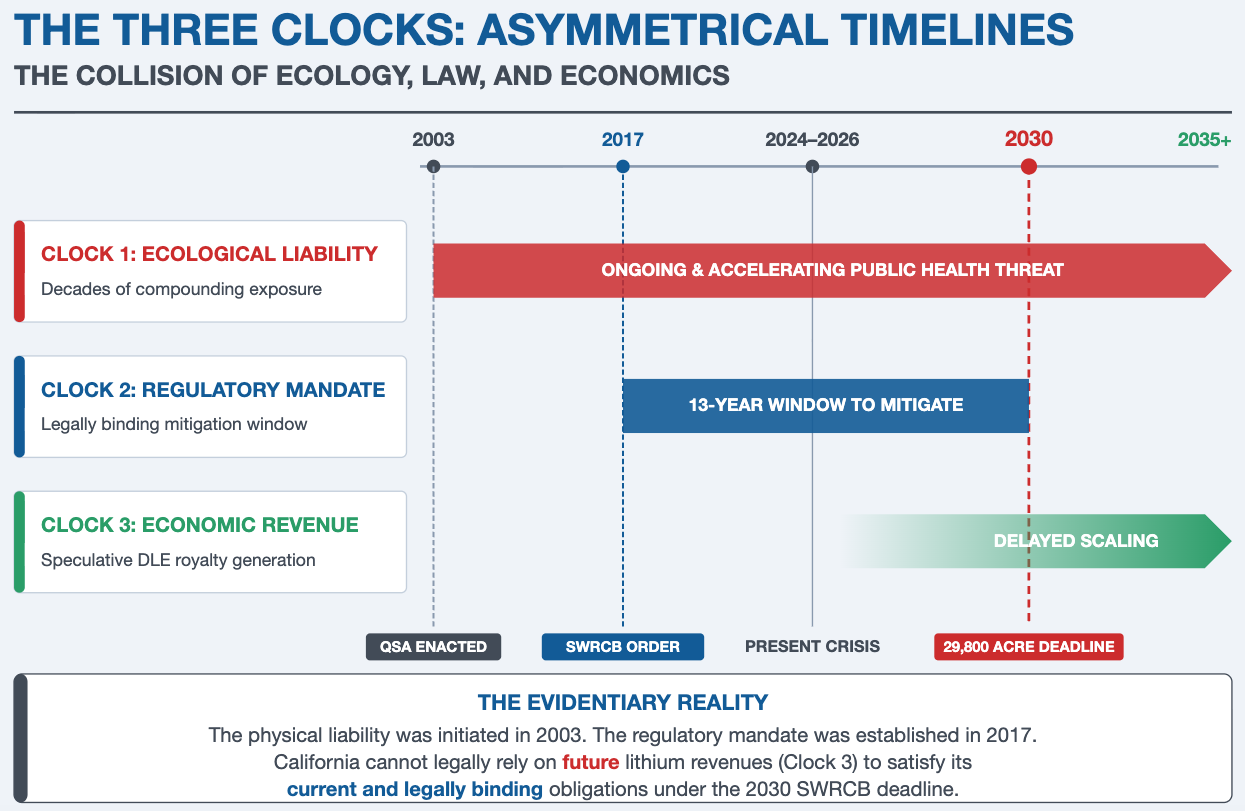
Three legally and physically distinct timelines are running simultaneously on the Salton Sea — ecological liability accelerating since 2003, a regulatory mitigation mandate with a hard 2030 deadline, and speculative lithium royalty revenue that has not yet materialized. California's current binding obligations cannot wait for Clock 3. Source: SWRCB Order 2017-0134; LAO 2024-25 Budget Analysis; California Energy Commission. Graphic: Silex Law.
Additional Resources
California State
Salton Sea Management Program — California Natural Resources Agency. The state's primary hub for SSMP planning documents, annual progress reports, and habitat and dust suppression project status.
The 2024-25 Budget: Salton Sea Funding and Oversight — Legislative Analyst's Office (February 2024). Analysis of state funding commitments, acreage targets, and the enforcement gap between SSMP obligations and actual progress.
Salton Sea: Restoring a Degraded Resource — Legislative Analyst's Office (2019). Background on the state's restoration obligations under the 2003 QSA and the SWRCB's 2017 Stipulated Order.
State Water Resources Control Board — Salton Sea — The SWRCB's page for the 2017 Stipulated Order, including compliance monitoring and water right transfer proceedings.
Lithium Valley Recommendations: Progress and Updates— California Energy Commission. Tracks implementation of the 2022 Lithium Valley Commission recommendations on permitting, royalties, community benefits, and workforce development for geothermal lithium extraction in the Salton Sea region.
CEPA State Water Control Board, Division of Water Rights, Order WR 2017-0134. Order mandating California provide mitigation to the Salton Sea.
Tribal
Torres-Martinez Desert Cahuilla Indians — Official tribal website.
Torres-Martinez Desert Cahuilla Indians Claims Settlement Act, 25 U.S.C. §§ 1773–1773h — The 1986 federal settlement act confirming tribal land and compensation rights, including provisions addressing submerged reservation lands.
Federal
The Salton Sea: Background and Potential Federal Role — Congressional Research Service Report R46625 (updated July 2021). Comprehensive overview of the Sea's hydrology, ecosystem decline, restoration history, QSA obligations, air quality, and federal role. The most thorough single federal reference on the topic.
Salton Sea: In Brief — Congressional Research Service In Focus IF11104 (February 2019). Concise primer on the Sea's formation, the Colorado River connection, and federal restoration responsibilities. A useful starting point before reading the full R46625 report.
Geothermal Lithium — U.S. Department of Energy, Geothermal Technologies Office. Covers federal research into extracting lithium from geothermal brine, with the Salton Sea as the primary domestic focus area.
Journalism & Policy Analysis
Salton Sea — CalMatters. Ongoing investigative coverage of restoration politics, state funding disputes, and community health impacts.
California Lawsuit Could Affect Lithium Mining, Imperial Valley — inewsource (January 2025). Coverage of the CEQA litigation challenging Hell's Kitchen Lithium's environmental review.
Quantification Settlement Agreement — Water Education Foundation, Aquapedia. Accessible explainer on the QSA, its water transfer mechanism, and the mitigation obligations it created for the Salton Sea.
For ongoing legislative, litigation, and regulatory developments related to the Salton Sea — including the Hell's Kitchen appeal, Salton Sea Management Program acreage reporting, and water transfer developments under the Law of the River — see the Water Crisis Watch, Water Law Decisions, and Water Legislation Watch blogs.