
The Great Salt Lake Crisis
The Great Salt Lake is the largest saltwater lake in the Western Hemisphere and one of the most ecologically and economically significant bodies of water in the American West. It is disappearing. Over the past three decades, the lake has lost more than half its surface area and dropped nearly twenty feet from its historic average elevation. The exposed lakebed — hundreds of square miles of arsenic-laden sediment — generates toxic dust storms that blanket the Wasatch Front, where more than eighty percent of Utah's population lives and works. The lake supports a $2.51 billion annual economy built on winter tourism (lake effect snow), brine shrimp harvesting, mineral extraction, and migratory bird habitat. It moderates the regional climate and delivers lake-effect snowpack to ski resorts that anchor Utah's outdoor economy. None of that is recoverable if the lake drops below the threshold of ecological viability — a threshold scientists say is close. What is driving the lake toward that threshold is not drought alone. It is the cumulative effect of a century of water law that was designed to divert water to human use, had no mechanism to protect the lake's inflow, and — until recently — treated the act of leaving water in a river as waste.
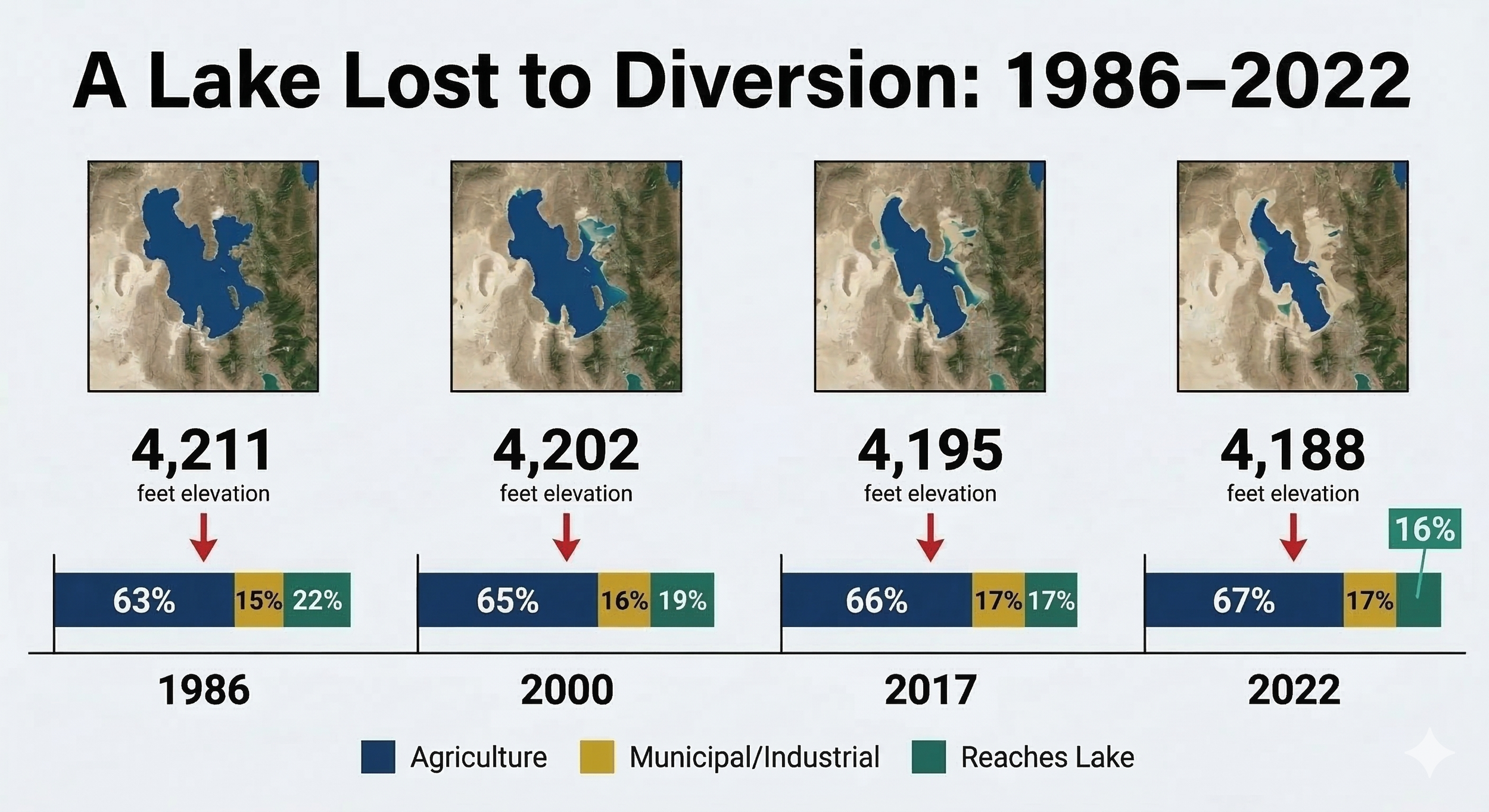
Three decades of upstream diversion reduced the Great Salt Lake from its 1986 high of 4,211 feet to a record low of 4,188 feet in 2022 — a loss of more than half the lake's surface area. Agriculture accounts for roughly two-thirds of consumptive use in the watershed. The share of water actually reaching the lake has declined steadily as diversions have held firm. Source: Utah Division of Water Resources; USGS; consumptive use estimates based on published watershed data. Graphic: Silex Law.
Why This Crisis Affects You
The Great Salt Lake is often discussed as an environmental concern. It is more accurately described as a public infrastructure crisis with direct consequences for human health, property values, and taxpayer liability — consequences that do not wait for anyone to care about the environment before they arrive.
The air quality threat is already unfolding. As the lake shrinks, it exposes lakebed sediment that has accumulated over a century of industrial, agricultural, and urban runoff. That sediment contains arsenic, lead, mercury, cadmium, manganese, and copper at concentrations that, in exposed lakebed samples, exceed EPA residential screening levels. When strong winds cross the playa, those particles go airborne. Fine particulate matter smaller than 2.5 microns can pass directly into the bloodstream, where exposure is associated with heart attacks, strokes, asthma, cancers, and developmental harm in children. The precise bioavailability of airborne arsenic from GSL sediment is still being measured, but researchers are unequivocal that high particulate matter concentrations are inherently hazardous to human health regardless of chemical composition — and plumes from the exposed lakebed already exceed federal air quality standards during wind events. Today, Salt Lake City experiences roughly fifteen dust storms per year originating from the exposed lakebed — compared to essentially none fifteen years ago. As many as 2.5 million people live within range of these events. A Republican state lawmaker has called the situation an “environmental nuclear bomb” if officials fail to act.
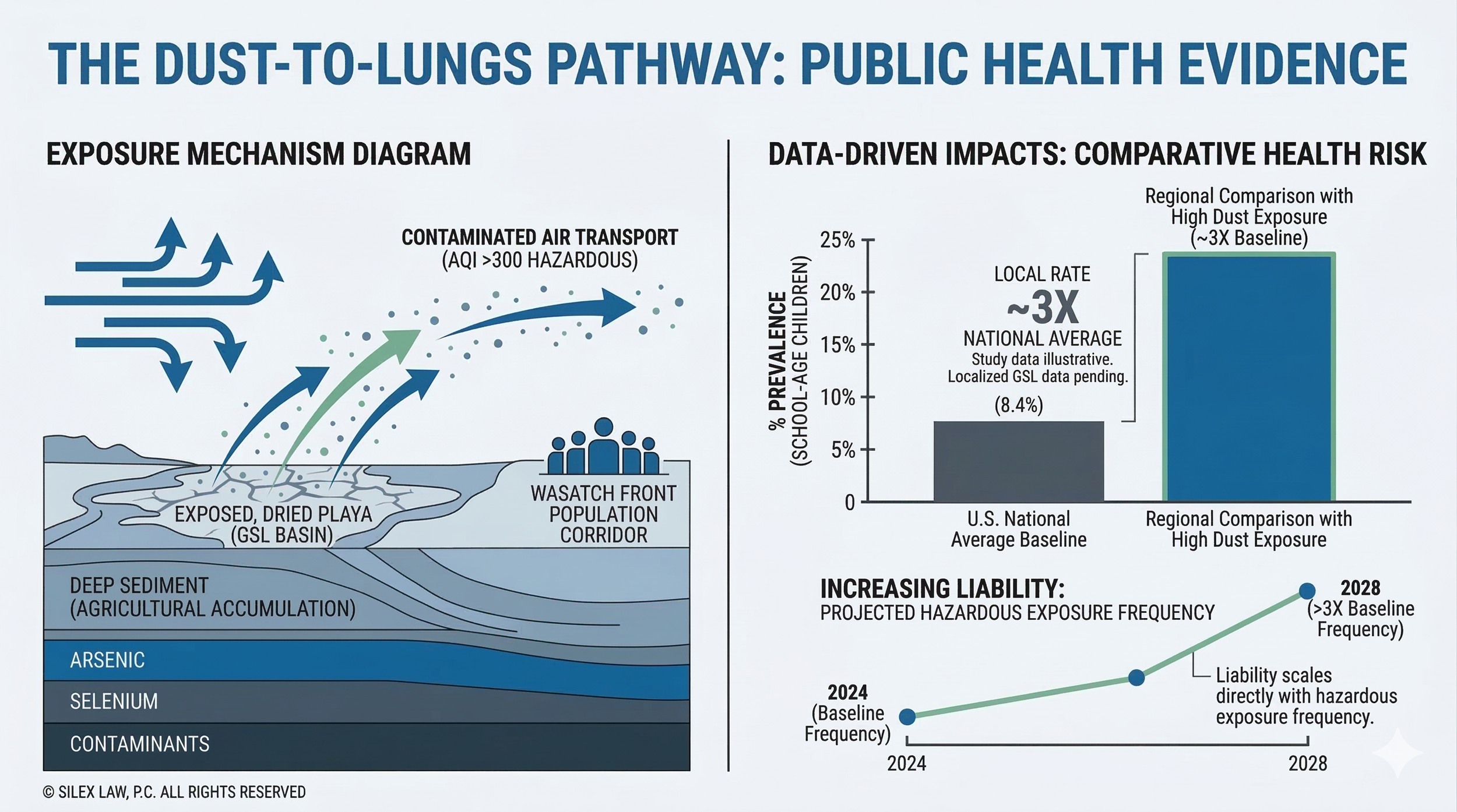
Airborne particulate matter — including arsenic and selenium — travels directly from the exposed GSL lakebed into the Wasatch Front, where 2.5 million people live. Dust storm frequency has risen from near zero to roughly fifteen events per year as the playa has expanded. Source: University of Utah Department of Atmospheric Sciences; Utah Department of Environmental Quality. Graphic: Silex Law.
The economic stakes extend well beyond Utah. The Lake generates $2.51 billion in annual economic activity—$1.13 billion from mineral extraction, $1.32 billion from ski and outdoor recreation, and $67 million from brine shrimp harvesting that supplies roughly one third of the world’s aquaculture industry. The Lake also provides a “lake effect” that contributes up to 10% of annual snowpack in the Wasatch Range — the same mountains hosting the 2034 Winter Olympics. If that snowpack is compromised, Utah’s outdoor recreation economy goes with it.
The taxpayer liability argument is not abstract. When Los Angeles drained Owens Lake, the exposed lakebed became the largest single source of particulate pollution in the country. Ratepayers have since spent more than $2.5 billion on dust mitigation at that one lake alone. The Great Salt Lake is orders of magnitude larger. The state’s recent $30 million purchase of the former U.S. Magnesium Superfund site already puts Utah taxpayers on the hook for an estimated $100–$200 million in remediation costs associated with a single parcel. This is what deferred action looks like in fiscal terms — before the full lakebed dust problem has even materialized.
The water policy decisions that govern the Great Salt Lake are water law decisions. They are made by water rights holders, state engineers, and legislators — not by people who enjoy watching migratory birds. The consequences of those decisions land on everyone in the blast radius, whether they made them or not.
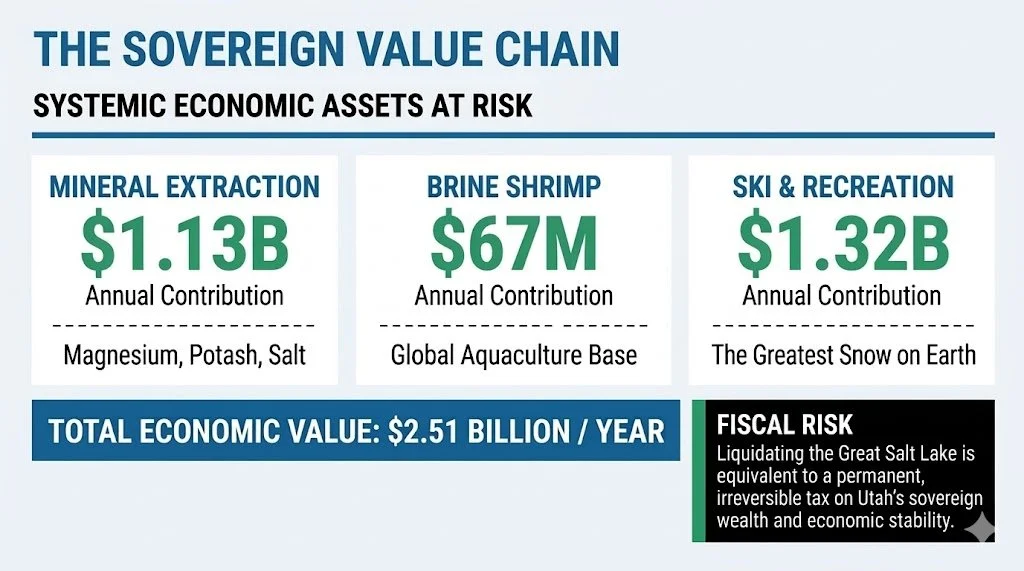
The Great Salt Lake generates $2.51 billion in annual economic activity — mineral extraction, brine shrimp, and ski and outdoor recreation combined. Losing the lake is not an environmental cost. It is a permanent fiscal write-off against Utah's sovereign wealth. Source: Great Salt Lake Advisory Council Economic Report; Utah State University. Graphic: Silex Law.
Why Water Law Created This Crisis
The Great Salt Lake is not dying because Utah lacks water law. It is dying, in significant part, because of how Utah's water law works — and because the legal system governing water allocation in the basin was designed without any mechanism to protect the lake itself.
Prior Appropriation in Utah
Utah water law operates on the prior appropriation doctrine — the same foundational framework governing water across the American West. The core principle is straightforward: the first person to put water to a recognized beneficial use acquires the right to continue that use, with priority over all later appropriators. In a shortage, junior rights are curtailed before senior rights are touched. First in time, first in right.
In Utah, water rights are administered by the State Engineer through the Utah Division of Water Rights. A valid water right specifies the source, the point of diversion, the place of use, the purpose, and the quantity. Rights are real property — they can be bought, sold, and transferred, subject to State Engineer approval and a no-injury rule protecting other appropriators.
The Terminal Lake Problem
The Great Salt Lake is a terminal lake — it has no outlet. Water enters from three primary tributaries (the Bear, Weber, and Jordan Rivers) and leaves only through evaporation. The lake's surface elevation is therefore a direct function of the balance between inflow and evaporation, and inflow is a direct function of how much water is diverted upstream before it reaches the lake. Under prior appropriation, every upstream diversion is a legal, vested right. The lake itself holds no water right. It is the terminal beneficiary of whatever water remains after every upstream appropriator has taken their share — and because the doctrine does not recognize the lake's need for inflow as a compensable interest, there was historically no legal mechanism to protect that inflow. The lake had no standing in the prior appropriation system. Upstream diversions currently consume roughly two-thirds of the lake's natural inflow.
The Use-It-or-Lose-It Doctrine
Prior appropriation's companion rule compounded the problem. A water rights holder who fails to put their water to beneficial use risks forfeiture — the "use it or lose it" doctrine. Historically, "beneficial use" in Utah meant consumptive use: diversion and application to agriculture, municipal supply, or industry. Leaving water in a stream or allowing it to flow to the lake was not beneficial use. It was waste. The practical consequence was a structural bias toward maximum diversion. Water rights holders had a legal incentive to divert their full appropriation every year, whether or not they needed it, to preserve their rights against a forfeiture challenge. The law did not simply fail to protect the lake — it actively discouraged the behavior that would have preserved it.
The 2022 Reform: HB 33
The Utah Legislature partially addressed both problems in 2022 with HB 33, the Instream Water Flow Amendments. The bill made two significant changes. First, it expanded the definition of beneficial use to include environmental instream flows, specifically including flows to the Great Salt Lake — closing the doctrinal gap that had made conservation legally equivalent to waste. Second, it suspended the use-it-or-lose-it doctrine for water rights voluntarily leased for instream flow purposes, so that a rights holder who leases their water to the state or a qualifying entity for delivery to the lake does not forfeit their right by non-use during the lease period. HB 33 is significant reform. But it operates entirely within a voluntary framework — it created a market for water to reach the lake; it did not mandate deliveries. The gap between what voluntary leasing can deliver and what the lake's hydrology requires remains very large, and closing it will require tools the Legislature has not yet deployed.
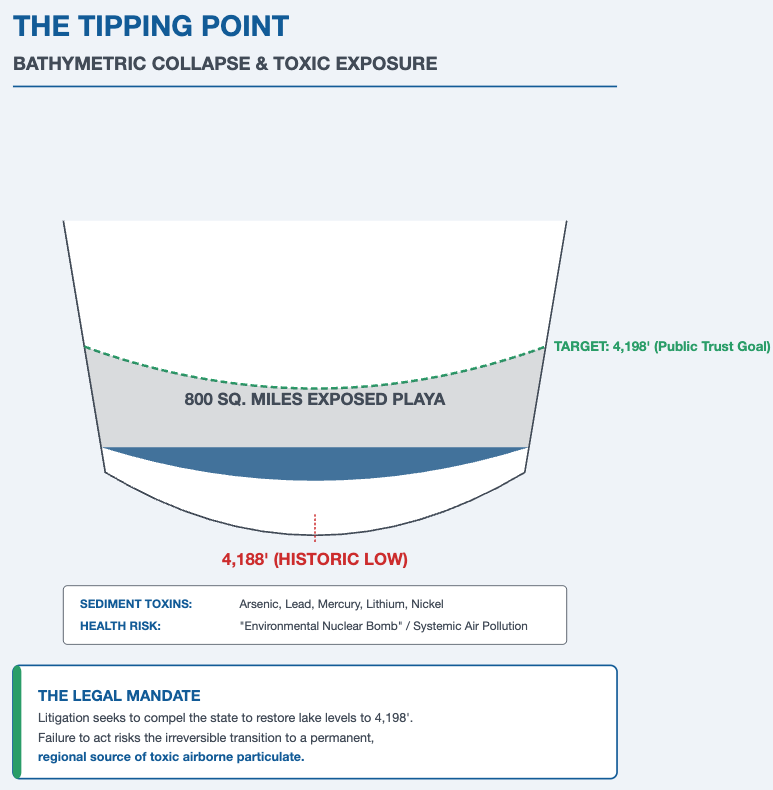
A ten-foot drop from the Public Trust target elevation of 4,198 feet to the 2022 record low of 4,188 feet has exposed 800 square miles of playa containing arsenic and heavy metals. Source: Utah Department of Natural Resources; U.S. Geological Survey. Graphic: Silex Law.
The Public Trust Doctrine and the Litigation
Running parallel to the prior appropriation system is a second legal framework with deeper constitutional roots — and potentially more coercive reach.
Utah firmly recognizes the public trust doctrine as applied to navigable waters. Rooted in the state's constitution, statutes, and common law, the doctrine establishes that the state holds the lands underlying navigable waters — and the waters themselves — in trust for the benefit of the public. The state acts as trustee, with an inalienable fiduciary duty to preserve these resources for public uses including navigation, commerce, recreation, and ecological health.
In September 2023, a coalition of environmental groups sued the Utah Department of Natural Resources, the Division of Water Rights, and the Division of Forestry, Fire and State Lands, arguing that the state has breached that fiduciary duty by allowing upstream diversions to reduce the lake to the point of ecological collapse. The plaintiffs seek a court order requiring the state to manage water rights to guarantee a minimum healthy lake elevation of 4,198 feet above sea level.
In March 2025, Third District Court Judge Laura Scott issued a critical ruling allowing the lawsuit to proceed, rejecting the state's motion to dismiss. The ruling resolved several threshold questions with significant implications for Utah water law. The state had argued that the public trust doctrine protects only the lakebed — the lands underlying the water — not the navigable waters of the lake itself. Judge Scott rejected that position, holding that Utah's public trust doctrine encompasses the navigable waters of the Great Salt Lake and that the state bears an ongoing fiduciary duty to protect those waters from substantial impairment.
On remedies, however, Judge Scott drew a significant boundary: while allowing the breach-of-duty claim to proceed to discovery and trial, she indicated that she could not issue a direct order compelling modification of perfected upstream water rights, citing feasibility concerns and separation of powers with respect to legislative action. That boundary defines the central legal tension the litigation will have to resolve. The public trust doctrine and the prior appropriation doctrine are not easily reconciled. Prior appropriation vests water rights as real property with constitutional protections; the public trust doctrine asserts a sovereign obligation that may override those rights where the resource itself is threatened with substantial impairment. Courts in other western jurisdictions have had to navigate this same tension — most notably in California, where National Audubon Society v. Superior Court (1983) established that the public trust doctrine can require reconsideration of previously granted water rights affecting Mono Lake. Whether Utah courts will follow a comparable path — and how far — is the central open question this litigation is now positioned to answer.
The Legal Response
The Office of the Great Salt Lake Commissioner
In 2023, the Utah Legislature created the Office of the Great Salt Lake Commissioner, establishing for the first time a single point of governmental accountability for the Lake's recovery. The Commissioner is appointed by the Governor and confirmed by the Senate, reporting to the Governor, the Speaker of the House, and the Senate President. The office is charged with developing and maintaining a long-term strategic plan for the lake, coordinating the work of the multiple state agencies with jurisdiction over different aspects of the lake and its watershed — the Division of Water Rights, the Division of Forestry Fire and State Lands, the Department of Environmental Quality, and others — and convening the industry, agricultural, environmental, and tribal stakeholders whose cooperation is necessary for any recovery effort to succeed. Governor Cox appointed Brian Steed as the inaugural Commissioner in May 2023; Steed completed the office's first comprehensive strategic plan by December of that year.
The Commissioner's office is a coordination mechanism, not a regulatory one. It can convene, plan, and advocate, but it cannot compel water rights holders to lease or dedicate their water to the lake, and it cannot modify perfected water rights. Its effectiveness depends on voluntary participation by upstream users and adequate funding from the Legislature — both of which have been partial and inconsistent. In 2025, the Legislature moved the Commissioner's office within the Department of Natural Resources and established a Great Salt Lake Trust Council to oversee watershed enhancement efforts, continuing a pattern of structural refinement that reflects both growing institutional commitment and ongoing uncertainty about the right governance model.
The Water Market Framework
HB 33's voluntary leasing mechanism is the primary legal tool for getting additional water to the lake. A water rights holder with an approved right can lease that water to the state — temporarily suspending their consumptive diversion — and receive payment while their use-it-or-lose-it protections remain intact. The state then ensures the leased water flows to the lake rather than being diverted upstream.
The 2026 legislative session has continued building out this framework. HB 348 would streamline the administrative process for transferring water rights to lake-beneficial uses, addressing bottlenecks in the State Engineer's approval process that have slowed voluntary transactions. HB 410 would appropriate $5 million specifically for farmer leasing programs, targeting agricultural users — who account for the overwhelming majority of upstream diversions — as the population most critical to any meaningful increase in lake inflows.
These are constructive incremental steps. But the gap between the water the voluntary market has so far delivered and the volume the lake's hydrology requires to stabilize and recover remains very large. The science is not in dispute: the lake needs inflows on a scale that voluntary participation, even well-funded, has not approached. The legal framework created by HB 33 works as designed — the market exists, transactions are occurring, water is reaching the lake. The question is whether a market-based approach operating at current scale can close a gap of that magnitude, or whether more directive tools will ultimately be required.
The Limits of the Voluntary Framework
That question is the central tension in the Great Salt Lake's legal future, and it runs directly through the public trust litigation discussed above.
The Legislature has so far declined to use mandatory curtailment authority — the power to compel upstream water rights holders to reduce diversions in order to protect the lake's inflow. The reasons are partly legal (the separation of powers concerns Judge Scott identified, and the constitutional weight of perfected water rights as property), partly political (the agricultural economy of the Bear, Weber, and Jordan River watersheds has significant legislative representation), and partly philosophical (Utah's water policy tradition strongly favors voluntary transactions and market mechanisms over regulatory mandates).
The result is a framework in which the state has acknowledged the crisis, created the institutional and market infrastructure to respond to it, appropriated meaningful funding, and stopped short of the coercive tools that would guarantee delivery at the scale the science requires. Whether that gap closes through an expanding voluntary market, through the public trust litigation producing a judicial mandate, through future legislative action authorizing mandatory minimum flows, or through some combination of all three — is the open legal question that will define the Great Salt Lake's trajectory over the next decade.
Tribal Water Rights in the Great Salt Lake Basin
The Great Salt Lake sits in the Great Basin — an endorheic watershed with no outlet to the ocean and no connection to the Colorado River system. Its water comes from the western slope of the Wasatch Range and the highlands of southern Idaho and Wyoming, carried south by the Bear, Weber, and Jordan Rivers before reaching the lake. The tribal nations whose ancestral territories encompass this basin are not the Colorado River tribes, though there is overlap. They are the Goshute, the Paiute, the Shoshone, and the Ute — peoples who inhabited, traveled, and stewarded the Great Salt Lake and its tributary watersheds for time immemorial before the arrival of Mormon settlers who diverted the rivers, plowed the wetlands, and established the water law framework now at the center of the lake's crisis.
Ancestral Presence and Dispossession
The Goshute people's traditional territory explicitly encompasses the Great Salt Lake — known in Goshute as Tĭ'tsa-pa("Fish Water") or Pi'a-pa ("Great Water") — extending westward across the basin into present-day Nevada. The Northwestern Band of the Shoshone Nation wintered for generations along the Bear River, the lake's largest tributary, traveling its banks from the massacre site near present-day Preston, Idaho south to the Great Salt Lake itself. The Ute bands occupied the broader region including Utah Valley and the Wasatch Front before forced removal to the Uintah Basin in the 1860s severed their direct connection to the lake's watershed. The Paiute bands inhabited the southern and western portions of Utah's Great Basin.
The dispossession of these nations from the Great Salt Lake watershed is not a historical abstraction — it is the direct precondition for the water allocation crisis the lake faces today. The settlers who displaced them brought an agricultural economy that rerouted rivers, filled wetlands, and established the pattern of maximum diversion that prior appropriation then codified into law. The lake's decline began with that displacement and has accelerated through the legal framework that replaced the land management practices of the people who lived here first.
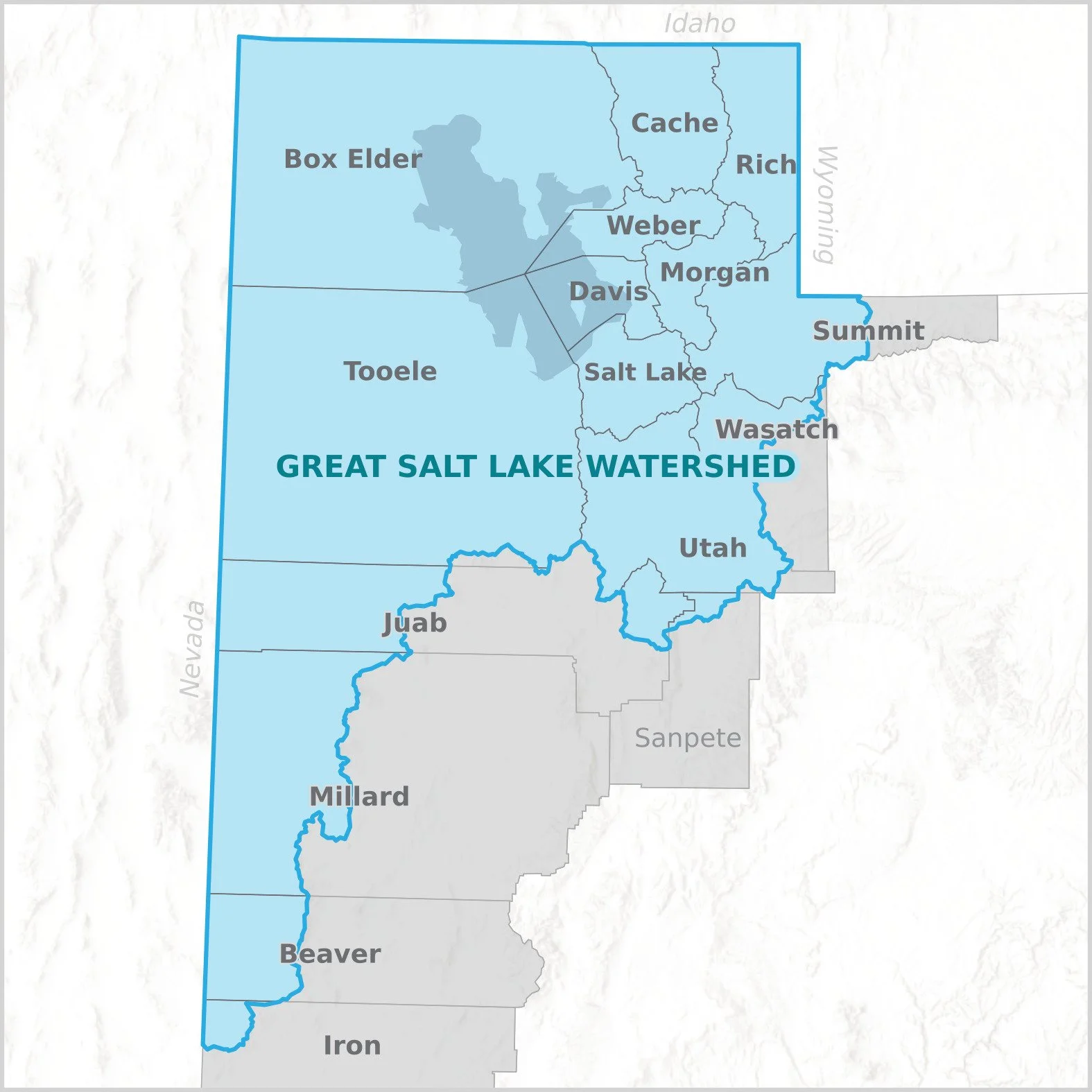
The Great Salt Lake watershed encompasses the Bear, Weber, and Jordan River drainages, along with Utah Lake and the West Desert basin. Together these five sub-watersheds deliver the lake's freshwater inflow. Source: Utah Division of Water Resources. Graphic: Silex Law
Formal Water Rights in the Basin
The formal legal picture of tribal water rights within the Great Salt Lake watershed — as distinguished from the Colorado River Basin — is largely unresolved. Utah's federally recognized tribes hold Winters doctrine reserved rights, but quantification proceedings for those rights within the Great Basin drainage have not produced the kind of settled, decreed entitlements that characterize the Colorado River Basin settlements. The Confederated Tribes of the Goshute Reservation and the State of Nevada have been working with a federal water team to settle Goshute water rights; those proceedings involve territory that straddles the Utah-Nevada border and includes portions of the Great Basin watershed.
The Ute Indian Tribe of the Uintah and Ouray Reservation — the holder of the most senior water right in the Colorado River Basin by virtue of its 1861 priority date — draws its water from the Uinta Basin, which drains east into the Green River and ultimately the Colorado River, not into the Great Salt Lake watershed. The Ute's legal connection to the GSL basin is therefore one of historical territory and governance rather than formal hydrological entitlement. The distinction matters for legal purposes even as it does not diminish the tribe's deep ancestral relationship to the lake and its surrounding region.
The Northwestern Shoshone and the Bear River
The most significant current tribal contribution to the Great Salt Lake's water future is not a formal water right proceeding — it is a restoration project. The Northwestern Band of the Shoshone Nation has been landless since the Bear River Massacre of January 29, 1863, in which U.S. Army soldiers killed an estimated 350 to 400 Shoshone men, women, and children at their winter encampment — one of the largest massacres of Native Americans in United States history. In 2018, the tribe purchased approximately 500 acres of its ancestral land at the massacre site near Preston, Idaho, beginning a systematic effort to restore the watershed hydrology that colonial agriculture had degraded over the preceding century and a half.
The restoration work is concrete and measurable. The tribe has planted tens of thousands of native trees and shrubs, freed Battle Creek from the agricultural canal that had trapped it for decades, and partnered with the U.S. Army Corps of Engineers, the Bureau of Reclamation, and university researchers to rebuild the natural meandering hydrology of the site. The restoration of native riparian vegetation, wetlands, and stream function is estimated to return approximately 13,000 acre-feet of water annually to the Great Salt Lake through improved watershed retention and reduced evapotranspiration losses from invasive species. That figure is modest relative to the lake's total deficit, but it is real, it is already underway, and it is being accomplished through the application of traditional ecological knowledge to a watershed that settler agriculture systematically degraded.
The Northwestern Shoshone's exclusion from the Great Salt Lake's formal governance structures — the Commissioner's office, the legislative leasing programs, the public trust litigation — reflects a broader pattern in which the tribal nations with the deepest historical relationship to the lake and its watershed have had the least institutional voice in the decisions shaping its future. That exclusion has begun to receive attention. Tribal leaders have engaged with watershed councils established by the Legislature in 2020, and state agencies have initiated more regular consultation. Whether that engagement produces formal tribal participation in the lake's governance structure — including recognition of tribal interests in how water rights are managed in the basin — remains an open question.
The Unresolved Legal Landscape
The absence of quantified, settled tribal water rights within the Great Salt Lake watershed is itself legally significant. Under the Winters doctrine, the tribal nations whose reservations were established from lands within or adjacent to the Great Salt Lake basin hold reserved water rights with priority dates tracing to their reservation's founding — rights that have never been extinguished and, in the Great Basin context, have largely never been formally quantified. Unquantified reserved rights do not disappear; they accumulate as a legal obligation that state water management must eventually account for. As Utah's prior appropriation system faces mounting pressure from the lake's decline, the public trust litigation, and potential mandatory curtailment measures, the unresolved status of tribal reserved rights in the Great Basin watershed adds a layer of legal complexity that state water planners have not yet fully addressed.
The four nations of the Great Salt Lake basin — Goshute, Paiute, Shoshone, and Ute — were the original stewards of a watershed that functioned sustainably for millennia before prior appropriation directed its flows away from the lake. Their legal rights in that watershed are incompletely quantified and institutionally underrepresented. The recovery of the Great Salt Lake, if it happens, will require confronting both of those facts.
The Rights of Nature Question
The legal tools the state has deployed to address the Great Salt Lake crisis — voluntary leasing, the Commissioner's office, the public trust litigation — all operate within the existing framework of Utah water law. They accept the premise that water rights are property, that the lake has no standing of its own, and that the appropriate legal response is to manage human property rights more carefully. A different tradition of legal thought challenges that premise directly. The Rights of Nature movement argues that ecosystems like the Great Salt Lake should hold legal rights of their own — the right to exist, to flow, to be replenished — enforceable through guardians acting on the ecosystem's behalf, just as guardians act for those who cannot represent themselves. In Utah, that argument provoked a legislative response so aggressive that it has itself become the subject of constitutional litigation.
The Movement and the Lake
The Rights of Nature framework has been developing in law and legal theory for decades, drawing on Christopher Stone's foundational 1972 essay Should Trees Have Standing? and accelerating through a series of international and domestic developments: Ecuador's constitutional recognition of the rights of nature in 2008, New Zealand's recognition of the Whanganui River as a legal person in 2017, and a growing number of municipal and state-level enactments in the United States. The framework gained particular traction in the Great Salt Lake context because the conventional legal tools had so visibly failed — the lake was losing surface area and elevation year after year while water rights holders continued diverting water they were legally entitled to divert, and the doctrine had no mechanism to stop it.
The grassroots organization Save Our Great Salt Lake became the primary Utah advocate for recognizing the lake's legal personhood. Its argument was direct: as long as the lake is treated as property — a resource to be allocated among human users — it has no legal standing to assert its own interest in survival. Granting the lake rights would change that, giving designated guardians standing to bring legal actions on the lake's behalf and creating a rights-based obligation that could not be satisfied by the gradual approach of voluntary conservation. A Utah State University poll found approximately sixty percent of state residents in support of using a Rights of Nature framework to protect the lake.
H.B. 249 and the Legislative Preemption
The Utah Legislature responded in 2024 not by debating the merits of legal personhood for the Great Salt Lake, but by foreclosing the question entirely. H.B. 249, the Utah Legal Personhood Amendments, passed the House 58-11 and the Senate 19-6 along party lines. Governor Cox signed it into law on March 21, 2024; it took effect May 1, 2024.
The statute is sweeping. It prohibits any governmental entity — courts, the legislature itself, local legislative bodies, and any entity with adjudicatory or rulemaking authority — from granting or recognizing legal personhood in bodies of water, land, plants, nonhuman animals, artificial intelligence, and any other entity that is not a member of the species Homo sapiens. Notably, the statute does not disturb the existing treatment of corporations, partnerships, and other nonhuman commercial entities as legal persons — a distinction critics have identified as revealing the law's actual target.
The statute is notable not only for what it prohibits but for how broadly it prohibits it. By extending the ban to courts as well as legislative bodies, H.B. 249 does not merely decline to grant the Great Salt Lake legal personhood — it purports to strip the Utah judiciary of its common law authority to recognize nonhuman legal rights, regardless of what future law, precedent, or constitutional development might otherwise require. That reach is the source of its constitutional vulnerability.
The Constitutional Challenge
The Nonhuman Rights Project filed suit in Utah's Third Judicial District Court on January 29, 2025, challenging H.B. 249 as facially unconstitutional under the Utah Constitution. The complaint argues that the statute is an impermissible legislative attempt to mandate legal conclusions — that by directing courts to reach a specific legal result regardless of the legal question presented, the Legislature has violated the separation of powers and stripped the judiciary of its core constitutional function of determining what the law is and who holds rights under it. The State of Utah filed a motion to dismiss in March 2025; that motion is pending before Judge Robert Faust.
The constitutional theory is significant beyond the Rights of Nature context. If a legislature can categorically prohibit courts from ever recognizing a category of legal right — not merely declining to create that right itself, but preventing courts from ever finding it — the implications extend well beyond environmental law. The Nonhuman Rights Project’s (NhRP) argument is that the common law develops through judicial recognition of new rights and new persons, and that a statute purporting to freeze that development permanently in a specific direction violates the constitutional structure that makes judicial independence meaningful.
What Remains Open
H.B. 249 closes the direct path to legal personhood for the Great Salt Lake through Utah's governmental institutions — barring a successful constitutional challenge. But it does not resolve the underlying legal problem the Rights of Nature movement was attempting to address: the lake has no independent legal standing, and the voluntary and regulatory tools available within the existing framework have not delivered water at the scale the lake requires.
Several avenues remain active or theoretically available. The public trust doctrine litigation, while not a Rights of Nature proceeding, advances a functionally similar argument — that the state's sovereign obligation to the lake as trustee creates enforceable duties that cannot be discharged simply by honoring existing property rights. Federal law may provide additional avenues; the Clean Water Act's treatment of the Great Salt Lake as a regulated water body creates federal jurisdiction that does not depend on Utah's personhood statute. And the NhRP constitutional challenge, if successful, would restore the judiciary's authority to develop the common law in this area — not a guarantee of any particular outcome, but a reopening of the question H.B. 249 attempted to permanently close.
The Rights of Nature debate in Utah is a window into a deeper legal question the Great Salt Lake crisis has forced into the open: whether the existing framework of property rights, voluntary conservation, and regulatory oversight is structurally capable of protecting an ecosystem facing collapse — or whether the law will need new categories, new rights-holders, and new legal architecture to do what the old tools have not.
What Comes Next
The Great Salt Lake's legal situation in 2026 is defined less by resolution than by accumulation. Several distinct legal tracks are now running simultaneously, none of them yet decisive, and the outcome for the lake will depend on whether any of them delivers water in meaningful volume — or whether some combination of all of them eventually does.
The Three Active Legal Tracks
Three distinct legal tracks are running simultaneously, none yet decisive. The table below summarizes each track's legal basis, current status, potential reach, key limitation, and next procedural milestone.
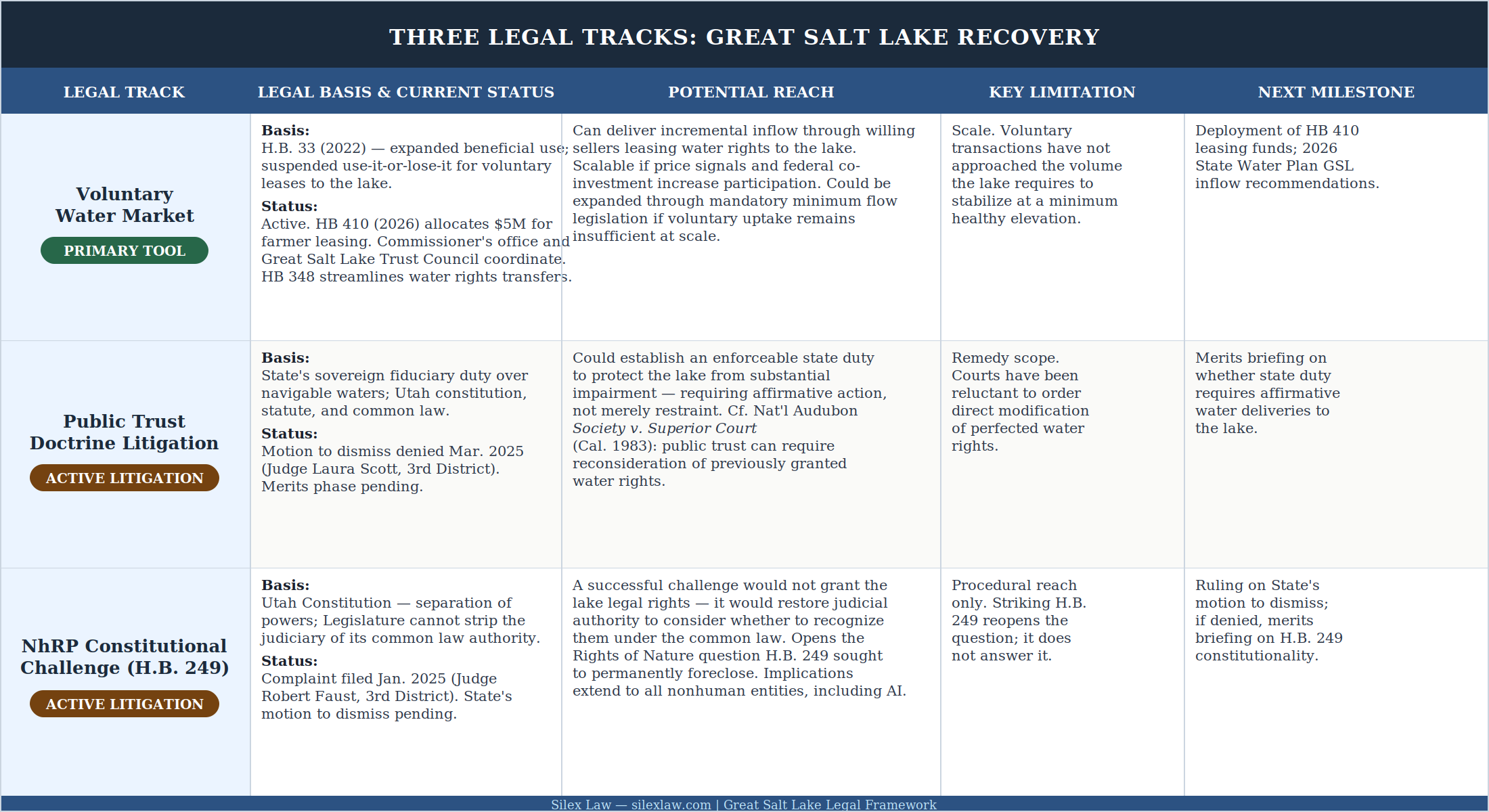
The three concurrent legal tracks addressing Great Salt Lake recovery as of early 2026. Tracks are not mutually exclusive — the lake's outcome will likely depend on some combination of all three. Litigation status current as of date of publication; developments tracked in the Water Crisis Watch and Water Law Decisions blogs. Source: Silex Law analysis. Graphic: Silex Law.
Two features of the current landscape are worth underscoring. First, the three tracks are not alternatives — they can and likely will run concurrently, and the outcome for the lake may depend on a combination of all of them rather than any single path. Second, the tracks operate on very different timelines: the voluntary market can deliver water incrementally starting now; the litigation tracks could take years to produce enforceable rulings, and the remedial questions remain open even if plaintiffs prevail on the merits.
The Bear River Question
One development that could significantly affect the lake's recovery prospects regardless of which legal track succeeds is the Bear River Development project. The Bear River is the lake's largest tributary, delivering roughly sixty percent of the lake's freshwater inflow. Utah's 2021 State Water Resources Plan identified Bear River development as a priority infrastructure project to meet projected Wasatch Front water demands. Diverting additional Bear River water before the lake stabilizes would offset conservation gains achieved through the voluntary market or court-ordered measures. Whether the state can simultaneously pursue lake recovery and major new Bear River diversions without conflict — and which interest takes priority if the two cannot be reconciled — is a question that has not been squarely addressed in the legislative or litigation record.
Federal Dimensions
Federal law provides tools that Utah state law cannot. The Clean Water Act's listing of the Bear River as an impaired waterbody creates federal jurisdiction over water quality in the lake's primary tributary. The Endangered Species Act's protections for species dependent on Great Salt Lake habitat create a separate avenue for federal regulatory involvement that does not depend on Utah's personhood statute or the state court system. Federal reclamation law and Bureau of Reclamation infrastructure investments in the basin create additional points of leverage — or constraint — depending on how federal and state priorities align.
Federal tribal water rights settlements, if and when they are negotiated for the tribal nations whose ancestral territories and unquantified Winters doctrine claims extend into the GSL watershed, will also shape how the water budget of the basin is ultimately allocated. Unresolved federal reserved rights are prior claims that exist independently of Utah's state water rights system, and their quantification will affect the arithmetic of basin-wide water availability.
The Structural Question
The individual legal developments described throughout this page — the voluntary market, the public trust litigation, the Rights of Nature debate, the constitutional challenge to H.B. 249 — each represent an attempt to work within or around the fundamental structure of western water law as it applies to a terminal lake. That structure allocates water as private property to individual users on a priority basis, with no inherent mechanism for protecting a shared resource that holds no water rights of its own and has no legal standing to assert any.
Whether that structure can be adapted, through judicial interpretation, legislative reform, or the gradual development of new legal categories, to protect an ecosystem that the existing framework helped bring to the edge of collapse is the question that will define Great Salt Lake law for the next generation of practitioners. The answer is not yet known.
Additional Resources
Utah State Government
Utah Division of Water Resources — Great Salt Lake. The Division’s primary Great Salt Lake page, covering current elevation data, the Lake’s ecological and economic significance, the Division’s role in basin planning and links to related programs.
Utah 2021 State Water Resources Plan. The Division of Water Resources’ third statewide water plan. Relevant to this page for its treatment of the Watershed Councils Act, the Bear River Development project, and the State’s water supply and demand projections through 2070. The 2026 State Water Plan is expected to supersede this document.
Great Salt Lake Basin Integrated Plan. The Division of Water Resources’ ongoing collaborative planning effort — authorized by HB 429 (2022) and co-funded with the Bureau of Reclamation — to develop an integrated water resource assessment and management framework for the entire Great Salt Lake watershed.
Office of the Great Salt Lake Commissioner — Strategic Plan (December 2023). The inaugural strategic plan produced by Commissioner Brian Steed's office, providing the state's formal framework for interagency coordination and lake recovery goals.
Utah Watershed Councils. The Division of Water Resources page for the statewide and local watershed councils established under HB 166 (2020). It includes information on the Great Salt Lake Watershed Council, which draws on the existing Great Salt Lake Advisory Council and integrates liaisons from the five tributary watershed councils.
Advocacy & Civil Society
Save Our Great Salt Lake. The grassroots organization that led the advocacy effort to recognize the Great Salt Lake’s legal personhood, and the principal public voice behind the Rights of Nature framework discussed on this page.
Legislation & Legal Materials
H.B. 33 (2022) — Instream Flow Amendments. The legislation that expanded beneficial use to include instream flows and suspended the use-it-or-lose-it doctrine for voluntary water leases to the Great Salt Lake. The statutory foundation for the voluntary water market.
Utah Code §§ 63G-32-10 et. seq.— Legal Personhood Restrictions (H.B. 249 (2024)). The full text of the legal personhood prohibition signed into law March 21, 2024.
NhRP v. State of Utah — Complaint (Jan. 29, 2025). The Nonhuman Rights Project's complaint challenging H.B. 249 as facially unconstitutional under the Utah Constitution on separation of powers grounds. Case No. 250900869, Third Judicial District Court, Salt Lake City, Judge Robert Faust presiding.
Academic & Research Resources
S.J. Quinney College of Law — Great Salt Lake Project. The University of Utah's law school maintains ongoing research, legislative tracking, and public education on Great Salt Lake legal issues. Professors Brigham Daniels and Elisabeth Parker co-direct the project through the Wallace Stegner Center and publish session-by-session legislative analysis during the Utah legislative session.
Abbott, M.W. et al. — Emergency Measures Needed to Reduce Great Salt Lake from Ongoing Collapse(2023). A multi-institutional scientific briefing documenting the lake's accelerating decline, quantifying the annual water deficit at 1.2 million acre-feet, and recommending emergency conservation measures. Authored by researchers from Brigham Young University, Utah State University, Westminster College, and other institutions.
Null, S. & Wurtsbaugh, W. — Water Development, Consumptive Water Users, and the Great Salt Lake(2020). A peer-reviewed textbook chapter providing a comprehensive analysis of the relationship between upstream water development and lake level decline, including quantification of consumptive use by sector and an evaluation of conservation and market-based approaches to increasing lake inflow. Published in Great Salt Lake Biology: A Terminal Lake in a Time of Change (Springer).
Richter, B.D. et al. — Reducing Irrigation of Livestock Feed is Essential to Saving Great Salt Lake(2024). A peer-reviewed study published in Environmental Challenges finding that 62% of river water bound for the lake is diverted before reaching it, and that stabilizing and recovering the lake will require a 35% overall reduction in consumptive water use — primarily through reductions in irrigated alfalfa and hay production.
For ongoing legislative, litigation, and regulatory developments related to the Great Salt Lake, see the Water Crisis Watch, Water Law Decisions, and Water Legislation Watch blogs.